Forbidden exoplanet TOI-5205 b shocks scientists with ‘unexpected atmosphere’
TOI-5205 b was first confirmed in 2023 based on data from NASA's Transiting Exoplanet Survey Satellite
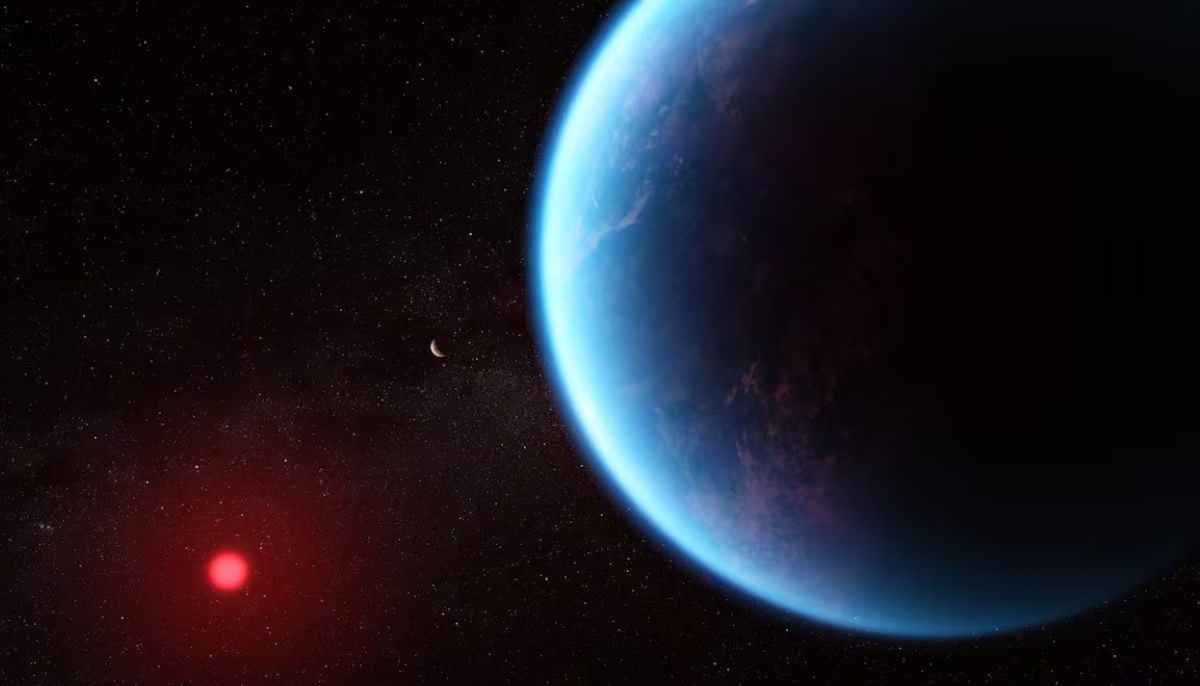
The James Webb Space Telescope has provided a detailed look at TOI-5205 b, a Jupiter-sized planet orbiting a small red dwarf (M dwarf).
The system is often called “forbidden” due to the unexplainable or quite impossible nature of its atmosphere. TOI-5205 b is roughly the size of Jupiter, but its host star is only about 40% of the Sun's mass.
Because the star is so small, the planet blocks a massive 6% of the star's light during a transit, making it an ideal candidate for atmospheric study.
The current planetary formation models have struggled to explain how such a massive planet could form around such a small host star.
Unexpected atmospheric chemistry
Recent atmospheric analysis has revealed a surprising chemical profile. The atmosphere contains far fewer heavy elements than expected. Specifically, it has lower metallicity than the star it orbits, going against typical formation patterns.
JWST also detected methane and hydrogen sulfide. According to findings published in the Astronomical Journal, the planet as a whole is about 100 times more metal rich than its atmosphere appears to be.
"We observed much lower metallicity than our models predicted for the planet's bulk composition…This suggests that its heavy elements migrated inward during formation and now its interior and atmosphere are not mixing," Kanodia explained.
“In summary, these results suggest a very carbon-rich, oxygen-poor planetary atmosphere,” she added.
The findings imply that heavy elements or metals migrated inward during the planet’s formation and are not mixing with the upper atmosphere. The results challenge our understanding regarding the early stages of giant planet formation.
The research is part of the "Red Dwarfs and the Seven Giants" program, which specifically targets rare, massive planets orbiting small M-dwarf stars to refine our models of the universe. TOI-5205 b was first confirmed in 2023.





-
 Why China is crashing a spacecraft into asteroid 2015 XF261
 -
 Australia's Great Barrier Reef at extreme risk of ‘ecosystem collapse’, scientists warn
 -
 James Webb Space Telescope reveals how black holes feed themselves
 -
 Japan’s upper-close asteroid flyby: Why scientists said it was too dangerous
 -
 Scientists find hidden structure inside Orion Nebula
 -
 China launches first of 1,000 space-computing satellites
 -
 Perseid meteor shower 2026: Here is everything to know about peak dates and best viewing times
 -
 Solar storm risks may be worse than previously thought, study finds
-
 Actor James Franco claims mysterious video shows alien outside his home
 -
Rare New Jersey meteorite reveals 'alien world chemistry', study finds
-
Astronomers find universe's faintest planet after 11 years of hide-and-seek
-
Scientists discover new ‘unusual-looking’ monkey species hidden in DR Congo forest