NASA scientists capture brain-shaped Nebula around dying star in shocking discovery
New images from NASA's James Webb Space Telescope are providing a clearer look at a mysterious and rarely studied nebula surrounding a dying star
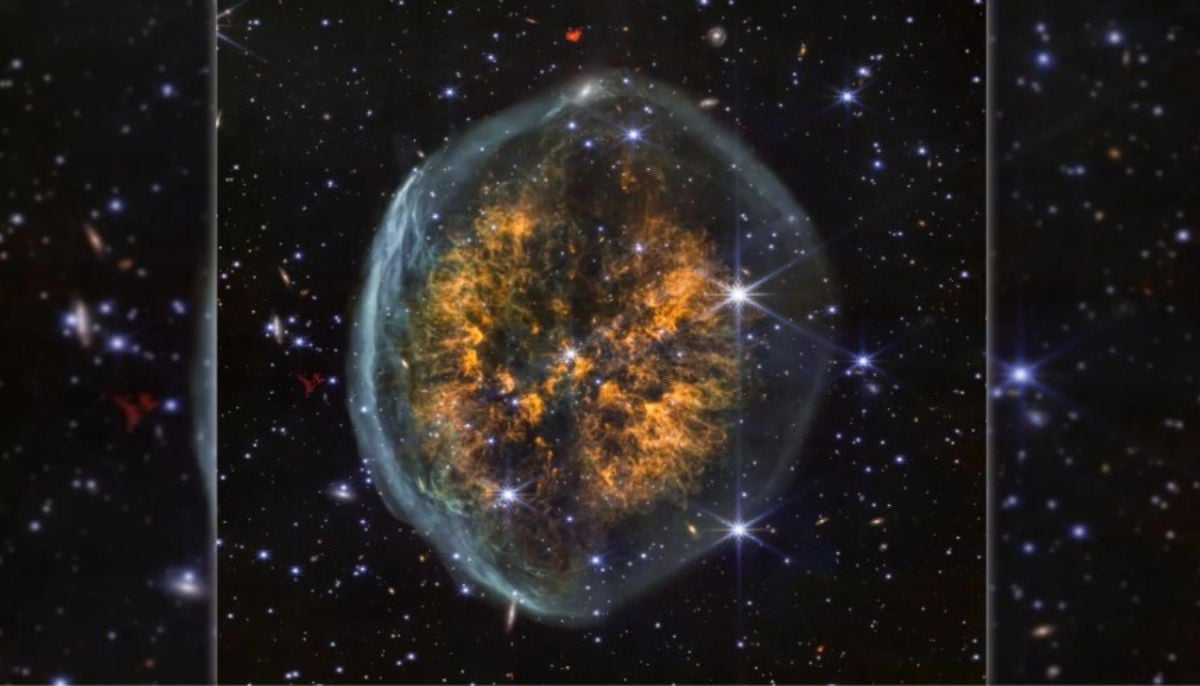
NASA astronomers have released shocking images of a new space discovery.
The James Webb Space Telescope has revealed new details in a bizarre nebula that looks like a brain floating in space.
Formed by a dying star, the “Exposed Cranium” nebula shows layered gas and a dark central divide that creates its eerie shape.
Webb’s infrared view suggests powerful jets may be shaping the structure.
New images from NASA's James Webb Space Telescope are providing a clearer look at a mysterious and rarely studied nebula surrounding a dying star.
The images capture a brief and dramatic phase in a star’s final evolution.
The nebula was first detected in infrared light more than a decade ago by NASA's now-retired Spitzer Space Telescope, but Webb's more advanced instruments provide a much sharper and more detailed view, making its brain-like structure stand out even more clearly.
The observations reveal new details about the structure of this unusual cloud of gas and dust and how it is changing over time.
The nebula shows clear signs of different stages in its development—an outer shell of gas that was expelled earlier and is made mostly of hydrogen, along with a more complex inner region that contains a mix of gases and more detailed structures.
These layers reflect how the star has shed material over time.
During this phase, stars shed their outer layers into space. While this may sound slow, it is relatively fast on cosmic timescales.
Scientists claim the James Webb Space Telescope is the most advanced space observatory ever built for studying the universe.
It is designed to investigate objects within our solar system, examine planets orbiting other stars, and explore the origins and structure of galaxies across cosmic history.


-
 Scientists develop technology to send smells through phones
 -
 Earth’s close encounter with giant asteroid Apophis is less than 3 years away
 -
 Chinese astronomers discover real-life three-body system unlike Liu Cixin’s fiction
 -
 Hunter’s Moon 2026: When and how to watch October’s full moon
 -
 Elon Musk’s Mars colonization dream faces reality check from Nobel laureate
 -
 NASA competition model 2.0 cuts mission selection by 45%
 -
 A ‘neglected’ neutrino may hold the key to why the Universe exists
 -
 Can cancer drugs be made in space? Here’s what the new mission aims to find out