Short attention spans are rising–Can friction-maxxing restore your focus?
The average attention span on screen declined from 2.5 minutes in 2004 to just 47 seconds in 2016
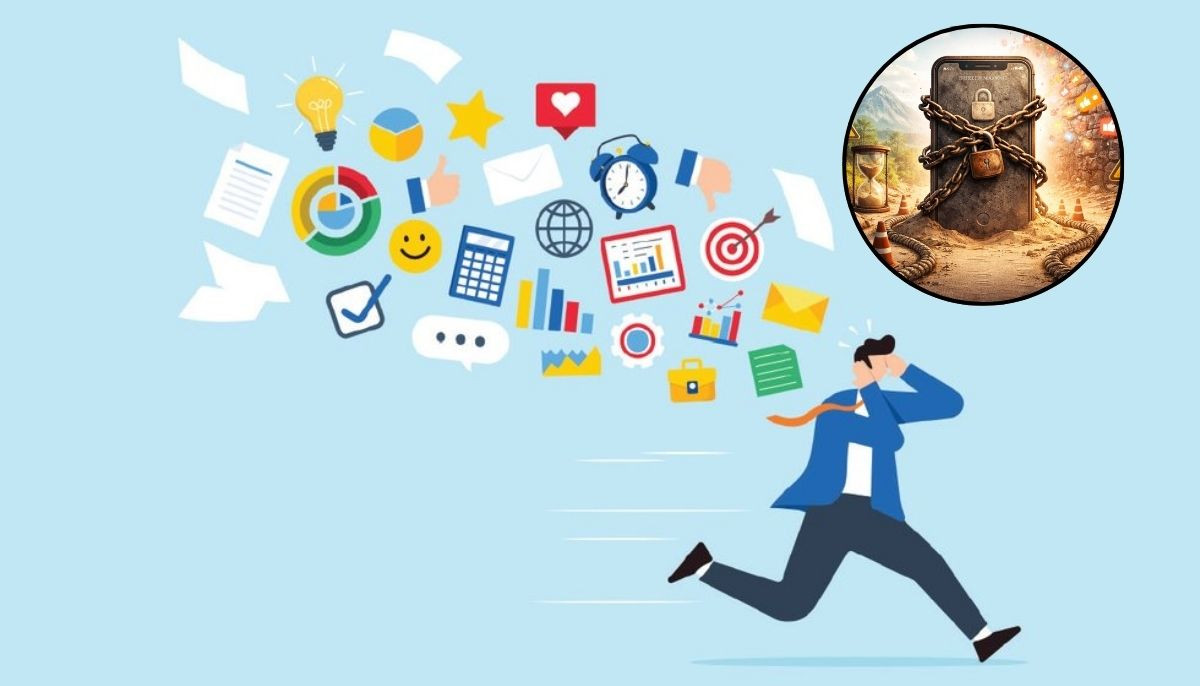
Humans are living in the age of technology powered by instant gratification and “hedonic” well-being. Owing to increasing reliance on tools and technologies for daily tasks, people are becoming addicted to digital convenience.
Here is the catch! Such convenience comes at a price. According to years of research regarding the impacts of digital tools, it has been suggested that we are facing a global pandemic of “short attention span.”
Moreover, with undue dependence, our emotional intelligence has weakened; cognitive and critical abilities have eroded, and spatial memory has started to fade.
This usually happens when humans outsource their thinking to AI chatbots to perform their tasks. Gone are the days when humans’ greatest power was their strong retention memory.
Besides the decline in cognitive qualities, humans have grown intolerant to slight inconvenience, boredom, and aloneness. In the age of social media, boredom has become an alien concept as reels and infinite scrolling have become suitable “kill switches” to eradicate boredom and fill the brains with momentary dopamine.
Unfortunately, despite technological optimization, we are less happy and lonelier, living in the illusion of socially meaningful connections and enhanced communication of social networks.
Here comes an emerging trend that encourages people to adapt to life’s nuances to build tolerance and resilience.
Friction-maxxing is a pervasive idea that embraces discomfort, suffering and inconvenience to pursue personal growth and perseverance.
The idea of friction-maxxing belongs to the old school which promotes conventional methods to kill boredom and reach the height of enjoyment. For instance, instead of watching YouTube and scrolling social media, people are instructed to read a book.
Hence, in a nutshell, the concept is not all about reducing the screen time, but the goal is to rebuild a "muscle" for discomfort and boredom, which are often the precursors to deep creativity.
Learning by suffering
According to Paolo Granata, an associate professor in AI literacy and digital media literacy from the University of Toronto, friction-maxxing’s philosophy is rooted in “learning by suffering.”
“Humans are capable of taking advantage of adversities and experiences in life to learn how to live a good life. If we take all those basic principles that really are the fundamentals of the ethical virtues in our society, in a digital world, again, learning by suffering.” Granata explains
When people learn to extract the meaning from life’s uncomfortable situations, they embark on the journey of character development and mental resilience.
Friction-maxxing: Panacea to attention span crisis?
Evolutionarily, humans are wired to conserve energy, thereby opting for a path with least resistance.
According to research conducted by psychologist Gloria Mark, the average attention span on screen declined from 2.5 minutes in 2004 to just 47 seconds in 2016.
The band of experts suggested that when people rely on tools like AI, GPS and social media, they are weakening their muscles for critical reasoning, social intelligence, and spatial awareness. Consequently, humans experience mental fatigue and trouble focusing.
With the rapid use of artificial intelligence, we are "mortgaging our brain out", said Larry Rosen, a research psychologist and professor at California State University. It means by outsourcing thought to AI not only reduces mental efforts but makes humans cognitively crippled.
In the midst of the modern attention span crisis, friction-maxxing has emerged as an effective strategy to heal the attention span, restore focus and create meaningful activities.
Various research studies show that cognitively challenging and stimulating activities, such as reading, crafting, gardening, playing games and puzzles, and learning an instrument can preserve cognitive function in the age of social media.
‘Ikea effect’ and fulfillment
Studies show that humans, even animals, attribute more value to things they have worked hard to obtain. Such efforts fulfill a core psychological need for competence and self-validation, dubbed the “Ikea effect.”
Moreover, brain scan research also shows that our brain’s reward centers become more active when we are being paid off after work, which is called the “Effort Paradox.”
In contrast to tech-driven “hedonic well-being”, friction-maxxing promotes “eudaimonic well-being”, which focuses on self-realization and long-term fulfillment.
Friction as eustress
According to proponents, friction acts as eustress, a good stress that energizes rather than drains. Friction-maxxing is most useful when it helps individuals manage technology rather than being controlled by it, as suggested by Rosen.
“But even if friction-maxxing isn't the end-all solution we've been waiting for, ‘it doesn't hurt’. If people are putting in effort, it makes them more intentional and thoughtful,” says Mark.
Skepticism and concerns
However, not all the experts are convinced of the viability of friction-maxxing in managing the attention crisis and digital exhaustion.
Given the pervasiveness of technologies, some critics argue that it is hard not to rely on these tools.


-
 Why Meta is testing a ‘human concierge’ for its personal AI agent Muse
 -
 Apple announced new modular beats headphones: Everything to know
 -
 Chinese regulator probes DeepSeek and Moonshot over secret data routing
 -
 DeepSeek to brief UN Security Council on AI risks amid rising global tech rivalry
 -
 OpenAI, Anthropic push Australia for ‘conditional’ AI training approval
 -
 OpenAI, Sam Altman sued over Tumbler Ridge school shooting
 -
 Chinese AI firm Z.ai disables coding assistant features; issues apology after security backlash
 -
 OpenAI calls for US to take lead in global efforts to develop technical standards