Morocco dinosaur with bizarre armour, metre-long spikes shocks scientists
Spicomellus, 13-foot-long plant-eater, lived about 165m years ago and is now earliest known ankylosaur
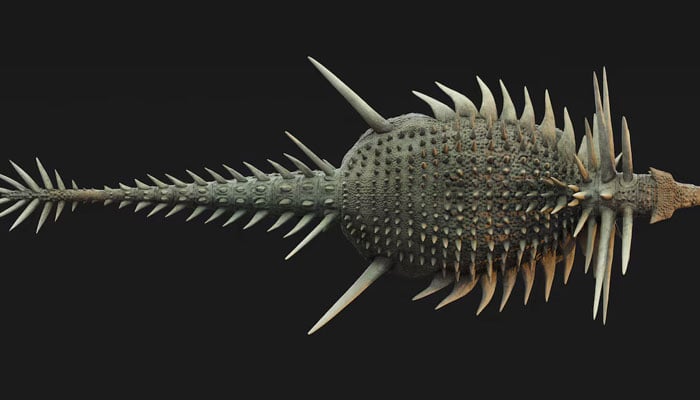
Scientists have discovered fossils of a bizarre Jurassic dinosaur in Morocco, covered in extravagant spikes and armour never seen before in any other animal, Reuters reported.
Named Spicomellus, the 13-foot-long plant-eater lived about 165 million years ago and is now the earliest known ankylosaur, a group of heavily armoured dinosaurs.
Researchers say Spicomellus had metre-long neck spikes, a collar of bony plates, and fused tail vertebrae that may have supported a weapon like a club. Its elaborate armour could have served both as defence against predators and as a display to attract mates.
Vertebrate palaeontologist Richard Butler of the University of Birmingham called its features “jaw-droppingly weird,” while lead author Susannah Maidment of the Natural History Museum suggested its impractical spikes were likely linked to courtship displays. The fossils were unearthed in Morocco’s Atlas Mountains between 2022 and 2023.
Its back was covered in short spikes, owing to ribs with spikes on their top surfaces. It had a bony collar with plates and two pairs of spikes projecting outward above the neck, including one 2.85 feet (87 cm) long that probably was even longer when the animal was alive. It also had a pelvic shield and two large outward-projecting spikes above its hips.
Distinctive fused tail vertebrae suggested that Spicomellus possessed a weapon at the end of its tail to fight off predators - perhaps a club or spikes of some sort - though one was not recovered among the remains.
Such fused tail vertebrae have been found only in ankylosaurs with tail weapons. This would indicate that tail weapons appeared in ankylosaurs about 30 million years earlier than previously known.
Ankylosaurs were among the most successful herbivorous dinosaurs. They are closely related to another group of plant-eaters called stegosaurs that boasted bony plates on the back and a spiky tail weapon.
Both groups arose during the Jurassic. But the ankylosaurs outlasted the stegosaurs, thriving until an asteroid struck Earth 66 million years ago at the end of the Cretaceous Period, ending the age of dinosaurs.
The best-known member of the group, Ankylosaurus, was larger than Spicomellus, at roughly 26 feet (8 meters) long, and inhabited western North America during the twilight of the dinosaurs. Its armour, including a formidable tail club, protected against predators, including Tyrannosaurus.
Early members of dinosaur groups often have fairly plain body plans compared to their later counterparts. Spicomellus shows that this was not the case with ankylosaurs.
"The armour of Spicomellus is much more elaborate than that of later ankylosaurs, and no later ankylosaurs have spiky ribs.
What is surprising to us is that the most elaborate ankylosaur armour of all time is present in the oldest member of the group.
Perhaps the simpler armour in later species reflects a shift towards the armour having a primarily defensive function due to increased predation pressure in the Cretaceous," when predators grew exceptionally large, Butler said.


-
 Starship flight 14: Why SpaceX’s first-ever orbital test matters to NASA’s Artemis
 -
 New study explains 364-day Qumran calendar puzzle
 -
 Why does time feel faster as you age? Science explains
 -
 Scientists name newly discovered snake after Guns N' Roses' Slash
 -
 SpaceX secures three new NASA crew flights: What to know
 -
 Sovereign AI fund in talks to back Political Sciences: What to know
 -
 What recent discovered Moon Crater Means for Future Astronauts
 -
 Scientists discover new wild cat species in Bolivia for the first time in a century