Scientists create game-changing honeybee 'superfood'
Scientists have developed an innovative ‘superfood' to fight against the decline of honeybees globally
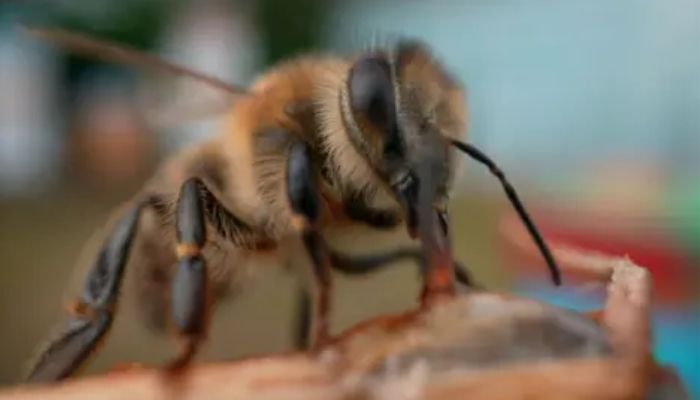
Scientists have developed an innovative “superfood” to combat the decline of honeybees against the threats of environmental degradation.
Honeybees are a pivotal part of food production and contribute to pollinating 70% of the world's leading crops.
Senior Professor Geraldine Wright at the University of Oxford has told BBC News regarding this revolutionary discovery, stating, "This technological breakthrough provides all the nutrients bees need to survive, meaning we can continue to feed them even when there's not enough pollen.”
Honeybees have been repudiating due to various factors including natural deficiencies and climate factors.
It has been observed that in the US, annual encampments losses have ranged between 40-50% in the last decade, and are expected to increase in the coming time.
The original source of food for honeybees are pollen and nectar from flowers which contain certain nutrients including lipids called sterols.
Sterols are crucial for their development, and this diet is pivotal for the bee’s survival and the health of the entire colony.
Honey farmers use supplementary food made from protein, flour and sugar to feed their bees when not enough pollen is available, specifically when they are accumulating money for sale.
It lacked the nutrients which honeybees required for their growth.
For that purpose, a group of scientists have been making efforts to identify which exactly sterols bees need for 15 years.
The series of experiments for months have proved successful to make a yeast that can produce the six sterols that bees need.
Geraldine Wright shed light on this successful innovation stating, “It’s a huge breakthrough. When my student was able to engineer the yeast to create the sterols, she sent me a picture of the chromatogram that was a result of the work.”
The “superfood” was fed to bees in the lab’s hives for a continued period of three months.
Nonetheless, new technology could be used to develop dietary supplements for other pollinators as well and subsequently opening new avenues for sustainable growth.
Whilst these results are promising, more field trials are needed to assess long-term implications on colony health.
Wright says that food will be specifically used during summers like this one when flowering plants appear to have stopped producing earlier.


-
 What Earth looks like from space: Crew-12 astronaut shares ‘powerful’ view
 -
 Elon Musk calls Mukesh Ambani ‘Prime Minister’ in Starlink row
 -
 Trump slams Norway over Nobel Peace Prize snub: ‘Indelible stain’
 -
 Sofía Vergara seems to respond quietly as ex Joe Manganiello’s memoir makes headlines
 -
 Taylor Swift and Travis Kelce’s planner defends their privacy plans after neighbour complaints
 -
 Newly unsealed texts show Ryan Reynolds and Colleen Hoover discussing Justin Baldoni
 -
 Inside Trump’s push to celebrate Christopher Columbus and restore his legacy
 -
 Stefanie Powers 'loves' Robert Wagner?
-
 Hurricane Simon: Forecast predicts further strengthening as it heads toward Mexico's Pacific coast
 -
Alyssa Milano calls out Megyn Kelly in open letter over Cornell case
-
Trump awards Elon Musk National Medal of Science at White House tech summit: What to know
-
Former ‘South Park’ writer launches website against Megyn Kelly