
China pursues space ambitions with launch of Tianwen-2
Tianwen-2 is tasked with collecting samples from near-Earth asteroid 2016HO3, and exploring comet 311P
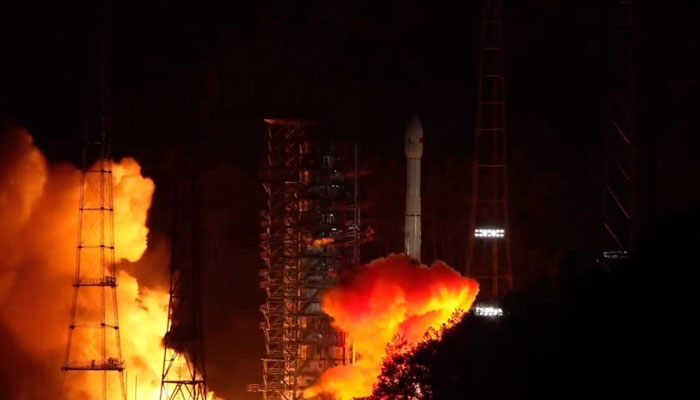
BEIJING: China has taken another big step in its space journey by launching the Tianwen-2 probe. The spacecraft will travel to a nearby asteroid to collect rock samples and bring them back to Earth.
This is the country’s first mission to an asteroid, and it shows China’s growing plans for space exploration.
The launch is part of China’s long-term goal to become a major space power.
Beijing has ploughed billions of pounds into its space programme in recent years in an effort to achieve what President Xi Jinping describes as the country’s "space dream".
It has built a space station orbiting the Earth and plans to run a crewed mission to the Moon this decade ahead of establishing a permanent base there.
A Long March-3B rocket carrying the Tianwen-2 probe blasted off from the Xichang launch site in southwestern Sichuan province "in the early hours of Thursday", Xinhua said.
"Shan Zhongde, head of the China National Space Administration, stated that the Tianwen-2 mission represents a significant step in China’s new journey of interplanetary exploration," the news agency reported.
Tianwen-2 is tasked with collecting samples from the near-Earth asteroid 2016HO3, and exploring the comet 311P, according to the country’s space agency.
Discovered by scientists in Hawaii in 2016, the asteroid is roughly 40 to 100 metres (130–330 feet) in diameter and orbits relatively close to Earth.
It is a "living fossil" consisting of ancient materials that can help scientists understand how the early solar system formed, Xinhua reported this week.
The comet, meanwhile, orbits between Mars and Jupiter and is alluring to researchers because it exhibits some features more commonly associated with asteroids.
The Tianwen-2 mission is expected to last around a decade.
China’s space programme is the third to put humans in orbit – after the United States and the Soviet Union – and has also landed robotic rovers on Mars and the Moon.
Its space station, Tiangong – whose name means "celestial palace" in Chinese – is the jewel in its crown.
Last month, China sent three astronauts to Tiangong for a six-month stint as part of the Shenzhou-20 mission.



-
 Hidden ‘dark galaxy' traced by ancient star clusters could rewrite the cosmic galaxy count
 -
 Astronauts face life threatening risk on Boeing Starliner, NASA says
 -
 Giant tortoise reintroduced to island after almost 200 years
 -
 Blood Falls in Antarctica? What causes the mysterious red waterfall hidden in ice
 -
 Scientists uncover surprising link between 2.7 million-year-old climate tipping point & human evolution
 -
 NASA takes next step towards Moon mission as Artemis II moves to launch pad operations following successful fuel test
 -
 Spinosaurus mirabilis: New species ready to take center stage at Chicago Children’s Museum in surprising discovery
 -
 Climate change vs Nature: Is world near a potential ecological tipping point?