‘Gateway to Hell’ in Siberia expands in size rapidly
The 300-foot deep ‘Gateway to Hell’ in Siberia crater is expanding outward at an alarming rate.
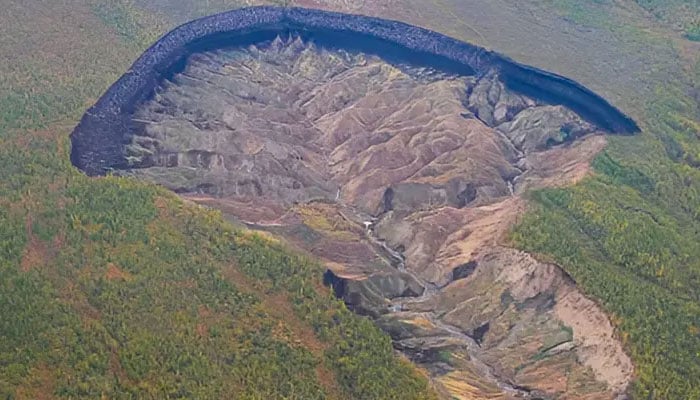
A crater known as the "Gateway to Hell" in the Yana Highlands of Siberia is expanding faster than scientists anticipated due to climate change.
The Batagaika slump, which first came to notice in 1991, now covers about 200 acres and can be seen from space captured in satellite images. The crater is growing rapidly under the effects of global warming.
Glaciologist Alexander Kizyakov and his team have found that the 300-foot deep crater is expanding outward at an alarming rate.
In a study published in Geomorphology, Kizyakov's team used remote sensing and field data from 2019 and 2023 to create a 3D view of the permafrost’s melting speed.
“The volume of the bowl-shaped retrogressive thaw slump (RTS) increases by approximately 1 million cubic meters per year,” the study revealed.
The crater's uncontrollable expansion poses a serious threat to the nearby Batagay River as it increases erosion on its banks and threatens the surrounding habitat.
Furthermore, the thawing permafrost releases frozen nutrients, which could significantly increase greenhouse gas emissions. Currently, 4,000 to 5,000 tons of organic carbon are being released annually from the permafrost. This number is likely to rise.
Given the recent high temperatures in the region, the rapid expansion is unsurprising, said Nikita Tananaev, a researcher at the Melnikov Permafrost Institute in Yakutsk, Russia.
"Higher retreat rates are expected to continue since we expect some more years with extremely high air temperature in this region to occur," he noted.
As the "Gateway to Hell" continues to grow, the impact on the environment and climate becomes a pressing concern for scientists worldwide.


-
 Can we finally find aliens? Scientists reveal a surprising new ‘organizational’ approach
 -
 Study reveals how to tell real alien life from chemical fakes
 -
 Scientists find hidden third ancestral group in Japanese genomes
 -
 SpaceX ‘Space Junk’ is on a collision course with the Moon, scientists say
 -
 Do you know what happened on May 10, 1967? NASA's M2-F2 disaster explained
 -
 Why the Southern Ocean is melting: Antarctica’s sea ice resilience reaches a breaking point
 -
 Giant black holes are cosmic ‘Frankensteins’ built by mergers, new study reveals
 -
 NASA’s Artemis 2 moon launch becomes the largest event in Space Coast history
-
 Is success written in your DNA? New study reignites nature vs nurture debate
 -
Researchers found 240-million-year-old giant mysterious 'sand creeper'
-
New solar-powered process turns plastic waste into clean hydrogen
-
Giant squid detected off Western Australia coast as deep-sea study reveals hidden species