Experts may have decoded mystery of dark matter in new study
Astronomers have found strong evidence of existence of dark matter while studying galaxies, other celestial bodies
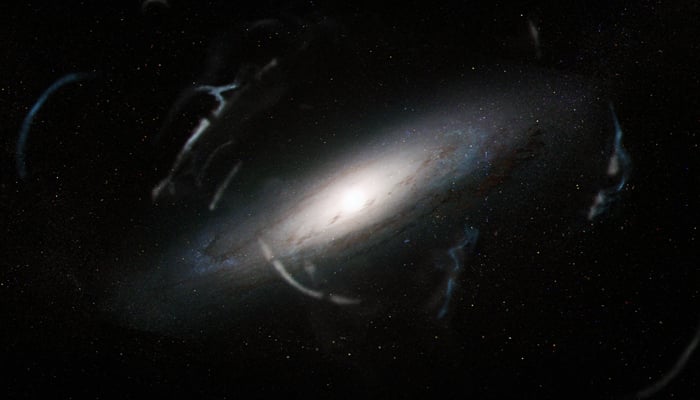
A new research recently published may have answered the question of dark matter that has baffled scientists for decades.
The newly published study in arXiv suggests that the waves of dark matter interacting with the planet’s upper atmosphere may form radio signals that could be detectable and helpful in studying the mysterious component of the universe, reported Live Science Sunday.
Astronomers have found strong evidence of the existence of dark matter while studying galaxies and other celestial bodies of massive structures in the cosmos.
To study the phenomenon, the European Space Agency (ESA) also launched its first probe Euclid aimed to study dark matter and dark energy.
The ESA’s probe was launched into space on Elon Musk’s Falcon 9 rocket on July 1, last year. Dark matter is an invisible material whose presence is known mainly based on its gravitational effects at a galactic scale.
Dark matter does not produce or directly interact with light but is thought to make up 85% of the universe, with the remaining 15% comprising normal matter.
What the dark matter is made of also remains a mystery.
For a recent study, experts explored models of ultralight dark matter that wasn't completely dark. It allowed it to interact extremely rarely with normal matter, even if they do, it is unnoticeable.
According to the outlet, such would be known when the dark matter interacts with plasma and when the frequency of its waves becomes parallel with the frequency of plasma waves. This is how radio waves would be generated.
Experts believe that our planet's ionosphere — a hot, thin layer of the upper atmosphere has particles that the waves would be generated, however, barely detectable.


-
 5 times video games actually went to space
 -
 Blue Origin hit with months-long delays after rocket explosion damages launch pad
 -
 Blue Moon 2026: Everything to know about the rare celestial event
 -
 Blue Origin’s New Glenn rocket explodes: NASA responds to impact on lunar base mission
 -
 Scientists map hidden Antarctic Marginal Ice Zone in Southern Ocean for first time
 -
 Who are the Artemis 3 astronauts? NASA announcement coming June 9
 -
 Blue Moon 2026: How it highlights the mechanics of our Solar System
 -
 China sends artificial embryos into space—Could humans reproduce in zero gravity?
-
 SpaceX IPO buzz intensifies as strategists debate $2 trillion valuation
 -
China to launch Shenzhou 23 crew to Tiangong space station
-
Antarctic blizzard sends fuel containers floating on an iceberg: Here’s why
-
SpaceX Starship test flight succeeds despite engine failures
-
Is this Earth 2.0? NASA’s James Webb telescope spots ‘rare’ giant exoplanet
-
SpaceX Starship launch delayed again: Here’s what went wrong
-
Why do scientists think Neptune’s moon Nereid survived violent cosmic collision?
-
NASA set to unveil major Moon Base strategy and mission update
-
SpaceX’s upgraded Starship V3 ready for high-stakes test flight: Where to watch live
-
Scientists hatch live chickens from 3D-printed eggshells: Could artificial wombs be next?