Nasa discovers 'Christmas Tree Cluster' sparkling in cosmic emerald glory
'Christmas Tree Cluster' is group of stars in Milky Way Galaxy that up to five million years old
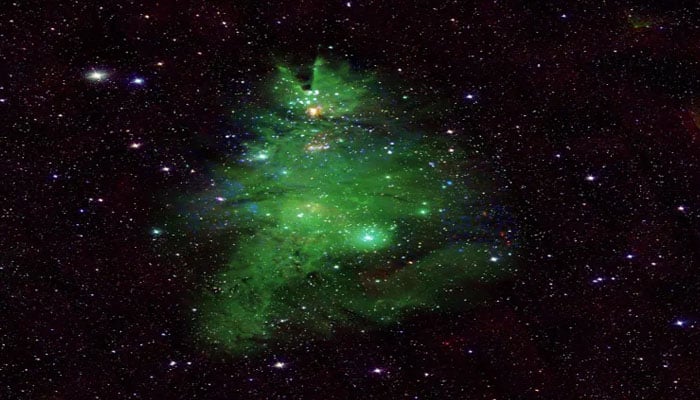
Nasa revealed its discovery of NGC 2264, a cluster of young stars that has an uncanny resemblance to a Christmas tree encircled by dazzling lights this week.
The "Christmas Tree Cluster" is a group of stars in the Milky Way that are between one and five million years old. It is situated about 2,500 light-years from Earth as reported by People.
Nasa stated on its website, releasing a composite image of the new cluster, saying “the stars in NGC 2264 are both smaller and larger than the sun, ranging from some with less than a tenth the mass of the sun to others containing about seven solar masses.”
“The blue and white lights are young stars that give off X-rays detected by Nasa’s Chandra X-ray Observatory,” the agency added. “Optical data from the National Science Foundation’s WIYN 0.9-meter telescope on Kitt Peak shows gas in the nebula in green, corresponding to the 'pine needles' of the tree, and infrared data from the Two Micron All Sky Survey shows foreground and background stars in white.”
Young stars like those in this cluster are described by Nasa as "volatile," prone to "strong flares in X-rays and other types of variations seen in different types of light."
The composite image has an animated version with blinking lights, but it was made intentionally to demonstrate where the stars visible in X-rays are located.
“In reality, the variations of the stars are not synchronised,” said the agency.


-
 April’s Pink Moon 2026: How to see the full moon in all its glory
 -
 First-ever primordial black hole discovery? Scientists reveal breakthrough
 -
 NASA Artemis II: Flight plan, risks and how it prepares humans for Mars
 -
 Superbugs on rise as climate change drives antibiotic resistance, study finds
 -
 Brain holds secret memory system, study finds
 -
 How to watch NASA's Artemis II moon launch live on April 1
 -
 New study shows dark spots in light waves outrunning the speed of light
 -
 Did you know Project Hail Mary features real astrophotography shots?