First-ever primordial black hole discovery? Scientists reveal breakthrough
In astrophysics, primordial black holes have always been theoretical
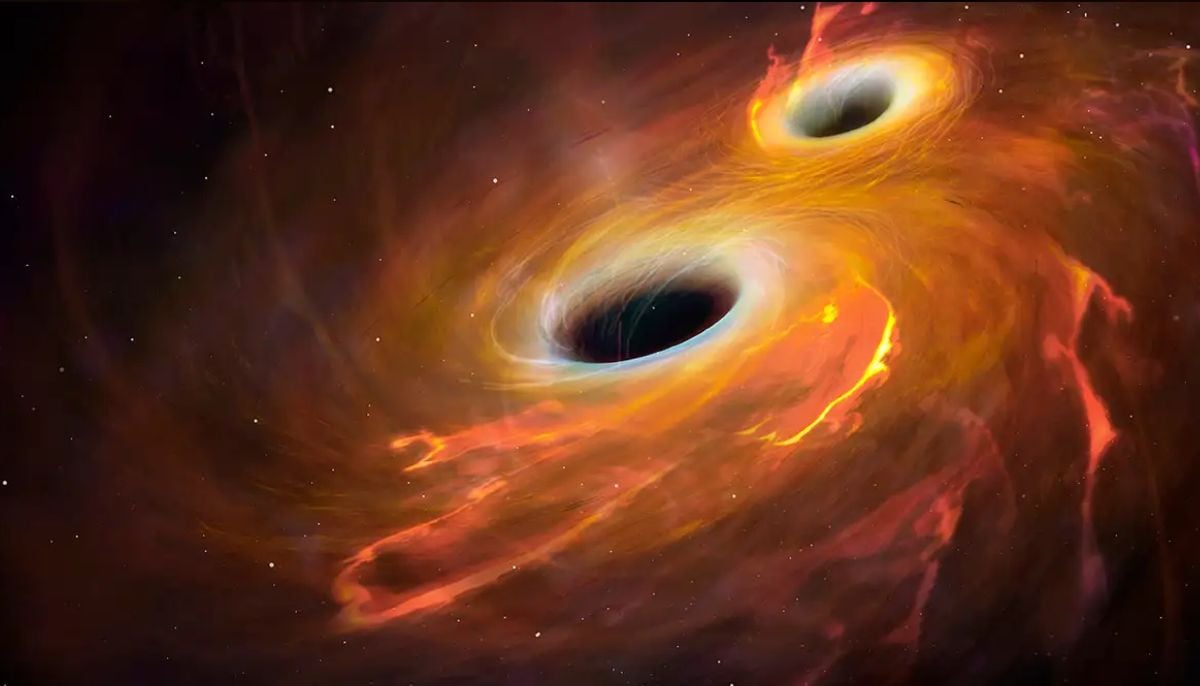
Scientists have edged closer to discover the universe's long-held mystery surrounding the existence of primordial black holes.
Unlike the familiar black holes born from the explosive collapse of supernovae, primordial black holes are theorized to have formed within the first second after the Bing Bang from dense pockets of subatomic matter.
For many years, primordial black holes have always been theoretical. However, recent series of evidence have moved these objects from the realm of pure theory to potential observable entities.
In a recent development, astrophysicists Alberto Magaraggia and Nico Cappelluti, from the University of Miami, have unravelled the mystery of primordial black holes by using the Laser Interferometer Gravitational-Wave Observatory (LIGO), located across two sites in Louisiana and Washington.
LIGO is known for detecting the gravitational waves triggered by the collision of two black holes.
The researchers found that a signal, known as S251112cm, captured by LIGO indicated a collision between two objects in which one of the objects was less than a single solar mass, possibly a primordial black hole.
Primordial black holes are expected to have much lower masses.
“The most common black holes form as the result of a supernova, the death of a massive star. So, their masses can range from a few times the Sun's mass to billions of solar masses.” Cappelluti said.
"We believe our study will aid in confirming that [PBHs] actually do exist," he added.
Moreover, the in-depth study of signal is needed to fully delve into details regarding the existence of a PBH with a subsolar mass.
A landmark study published in early 2026 and conducted by Elio Quiroga explores the detection of "PBH-H protoatoms", exotic systems where a primordial black hole acts as a nucleus, capturing a proton and an electron.
Researchers suggest that the James Webb Space Telescope (JWST) could identify these by their unique spectroscopic signatures in the far-infrared range.





-
 Why China is crashing a spacecraft into asteroid 2015 XF261
 -
 Australia's Great Barrier Reef at extreme risk of ‘ecosystem collapse’, scientists warn
 -
 James Webb Space Telescope reveals how black holes feed themselves
 -
 Japan’s upper-close asteroid flyby: Why scientists said it was too dangerous
 -
 Scientists find hidden structure inside Orion Nebula
 -
 China launches first of 1,000 space-computing satellites
 -
 Perseid meteor shower 2026: Here is everything to know about peak dates and best viewing times
 -
 Solar storm risks may be worse than previously thought, study finds
-
 Actor James Franco claims mysterious video shows alien outside his home
 -
Rare New Jersey meteorite reveals 'alien world chemistry', study finds
-
Astronomers find universe's faintest planet after 11 years of hide-and-seek
-
Scientists discover new ‘unusual-looking’ monkey species hidden in DR Congo forest