World
A guide to North Korea's 250km long demilitarised zone
North Korea's Demilitarised Zone is a 2km-wide buffer, stretching coast to coast across the peninsula
By Web Desk
Published July 19, 2023
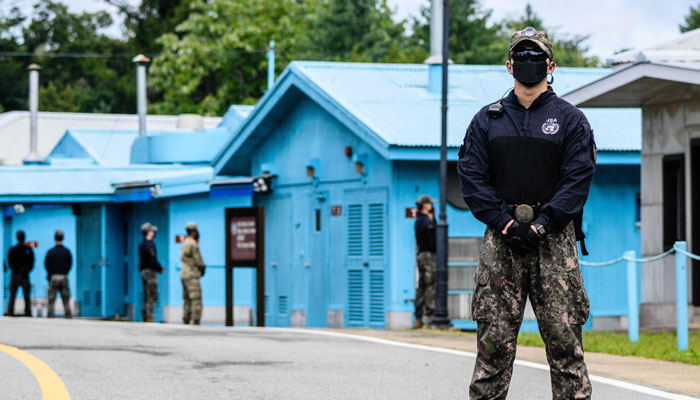
Authorities on Tuesday detained a US citizen in North Korea while he was touring the highly fortified Demilitarised Zone (DMZ) and crossed the inter-Korea border without authorisation, according to the United Nations Command which claims that the person trespassed the military demarcation line.
According to CBS News reports, the detained citizen is identified as a US soldier Private 2nd Class Travis King, who turned around at the airport and joined a border tour while being escorted back to the US for disciplinary reasons.
Advertisement
Here are some facts about the Demilitarised Zone which stretches 250 km long and separates two Koreas:
- The Demilitarised Zone is a line between South and North Korea which was established in the 1950-53 Korean War when China and North Korea fought a war with UN forces led by the US and ended with an armistice, not a treaty.
- The zone is a 2 km-wide buffer, stretching coast to coast across the peninsula, lined on both sides with razor wire, heavy armaments and tank traps.
- It is 60 km (37 miles) from Seoul and 210 km (130 miles) from the North Korean capital of Pyongyang.
- Inside the DMZ is the JSA. The so-called peace village of Panmunjom, where the armistice was signed in 1953, is located in the 800-metre-wide and 400-metre-long JSA zone.
- A Military Demarcation Line (MDL) marks the boundary between the two Koreas.
- Panmunjom is a cluster of distinctive bright blue buildings. The two Koreas have their own liaison offices and conference halls there, on each side of the MDL.
- At least six US soldiers are known to have defected to the North after the war, mostly in the 1950s and 1960s. The last one was in 1982. Five of the six crossed into North Korea through the DMZ.
- Under a 1953 deal, the UN Command and the North Korean military were allowed to dispatch no more than 35 troops to the JSA, and each of them can only possess one pistol or non-automatic rifle. But the number of soldiers and weapons increased as relations worsened.
- The troops face each other across the MDL in Panmunjom. Communication is often difficult despite the close conditions. During periods of high tensions phone hotlines often go unanswered, forcing US or South Korean officials to try to shout across the border.
- After a summit between the two Koreas in 2018, the two sides withdrew firearms from the JSA and reduced the number of troops to the original 35.
- Vast stretches of the DMZ have been no man’s land for more than 60 years, where wildlife has flourished undisturbed. Other parts of it offer an unsettling mix of military installations and tourist attractions.
- South Korea estimates the North operates about 160 guard posts along the DMZ and the South has 60.
- The DMZ is also littered with landmines planted over the decades - as many as 970,000 in the southern part alone, according to Landmine and Cluster Munition Monitor, a Geneva-based civic group.
- For years, both sides blared propaganda broadcasts over the DMZ into each other’s territory. The broadcasts ended after a 2018 military agreement.
Share this story:


-
 How Mark Fuhrman became one of the most controversial figures in O.J. Simpson trial
 -
 Irelands’ President Catherine Connolly speaks after King Charles meeting
 -
 Putin heads to Beijing as Russia pushes major China gas pipeline deal
 -
 UK braces for a late spring heatwave: Here’s what you need to know
 -
 Senate Republicans confirm nearly 50 of Trump’s energy and land picks: Here’s why
 -
 Ebola outbreak sparks global health emergency as deaths rise in Africa
 -
 Trump pushes to expand admission for White South African refugees
 -
 Missing Italian divers located after dangerous Maldives recovery mission