Was Blue Origin rocket explosion covered up by Jeff Bezos after signing Nasa contract?
Explosion occurred days after Blue Origin and SpaceX announced plans for lunar landing in May
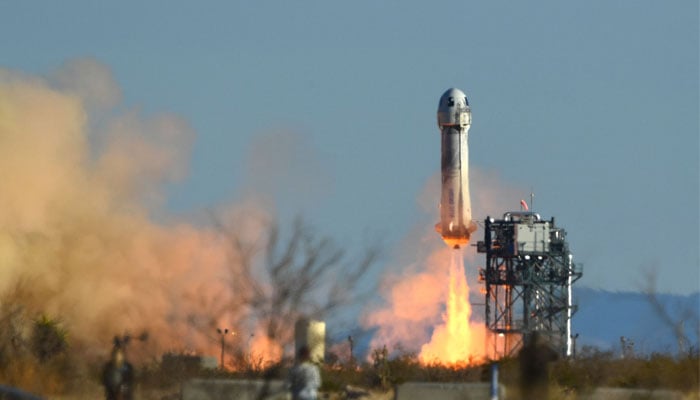
More than a month after Nasa gave Jeff Bezos, the founder of Amazon, his company Blue Origin to construct spacecraft for the moon landing, the aerospace company blew up its rocket last month without mentioning the event, according to a CNBC report.
The report, which cited unnamed sources, claimed that the unintentional explosion took place on June 30 at Blue Origin's testing facility in West Texas.
The 59-year-old entrepreneur's business later confirmed the incident, claiming that its team "ran into an issue while testing Vulcan's Flight Engine 3."
A spokesperson said: "No personnel were injured, and we are currently assessing root cause. We already have proximate cause and are working on remedial actions."
The explosion occurred just days after the US space agency revealed Blue Origin would work alongside Elon Musk's SpaceX to develop a spacecraft that would enable astronauts to land on the moon in May.
In 2021, Musk's aerospace company, SpaceX, received a $3 billion contract from Nasa as part of the Artemis moon programme, which will enable astronauts to return to the moon after Apollo's 1972 mission.
The Blue Origin contract is valued at roughly $3.4 billion, Nasa's exploration chief, Jim Free, said.
Vice President of Blue Origin John Couluris stated that the business will contribute "far north" of that sum.
"We’re making an additional investment in the infrastructure that will pave the way to land the first humans on Mars," Nasa Administrator Bill Nelson said in announcing the Blue Origin award.
"Our shared ambitions now are no less lofty than when President [John F.] Kennedy dared a generation of dreamers to journey to the moon," he added.
Taking to Twitter, Bezos said that he was "honoured to be on this journey with Nasa to land astronauts on the Moon — this time to stay."
Blue Origin recently completed its first flight-ready BE-4 engines, despite being initially planned for 2017, with June's explosion occurring during something known as an "acceptance test" (ATP).
ULA president Tory Bruno said Tuesday that ATP failures were “not uncommon, and a routine part of rocket development.”
“We analyse each for potential crossover, as a discipline,” he tweeted.
“Many other BE-4s have passed ATP and one on to hot fire. This one had failed an earlier ATP attempt and was reworked.”


-
 Moon water acts nothing like it does on Earth, study finds
 -
 Hawaii’s Hōlei sea arch collapses after centuries on Big Island: What happened
 -
 Solar system may have a much shorter lifespan than we thought
 -
 Singapore builds world’s ultra-precise clock outperforming US, China
 -
 NASA expands Moon base research with three new investigations
 -
 Are Europe's data centres hiding their water use?
 -
 SpaceX set to send Google AI chips into space for data centers
 -
 New report warns of record ocean warming and rising seas