
WHO warns of massive syringe shortfall in 2022; Germany’s unvaccinated defiant as rules tighten
Radeberg, Germany: The eastern German state of Saxony may have ordered tough curbs on the unvaccinated to push them to get the Covid-19 jab, but shop assistant Sabine Lonnatzsch, 59, is unmoved.
The new rules are "discriminatory" because they are "pushing the unvaccinated further into a corner," she tells AFP. She won’t change her mind about getting inoculated -- she just won’t go to restaurants or events anymore.
"I’ve had corona cases in my family and in my eyes it is nothing more than a bad flu," she says. With Covid-19 infections rocketing in Germany, Saxony this week became the first to largely exclude unvaccinated people from indoor dining, cinemas and bars.
The new rules, likely to be emulated by other states in the coming weeks, are designed not only to reduce the spread of Covid-19 but also to encourage more people to get inoculated. But Lonnatzsch is not the only one resisting the jab in the town of Radeberg in Bautzen district, which has one of the lowest vaccination rates in the country at just 45.7 percent.
The clothing store No 1 Mode where she works has a sign in the window that lets customers know that all are welcome -- regardless of vaccination status. Across the town square, the co-owner of Cafe Roethig also has no plans to get the vaccine.
Like many people in the region, Carola Roethig, 58, is "not convinced" by the jab because "it was developed in such a short space of time". The district of Bautzen has one of the highest incidence rates in the country at 645.3 cases per 100,000 people, but Roethig is not worried about catching the virus.
The new rules are "definitely bad for business," she says at the cafe’s bakery counter, which is lined with untouched fresh cakes, tarts and iced donuts. "Many of our customers are not vaccinated, so we are losing income, because fewer people are coming in," she says. The rules are also bad for her personal life.
"I’m not allowed to go to a restaurant in the evening and have a nice dinner with my husband. I don’t think it is right." Outside the cafe, 40-year-old Susan feels the same. "Nothing would convince me" to get the jab, she says, without giving her last name.
"I see no sense in it because (vaccinated people) can still get the disease and infect others." The new rules come as new infections surge in Germany, with the national incidence rate reaching 213.7 cases per 100,000 people over the past seven days on Tuesday -- a record since the pandemic began.
The political parties looking to form a coalition government after September’s election have so far ruled out compulsory vaccinations and general lockdowns to tackle the surge. But with just 67 percent of the population fully jabbed, ministers say encouraging more people to get vaccinated is key to bringing the numbers down. In neighbouring France, more than 74 percent are fully vaccinated, and in Spain the figure is more than 77 percent. German health experts have named a target rate of 85 percent.
However, in a recent a Forsa survey carried out for the health ministry, 65 percent of unvaccinated respondents declared there was "no way" they would take a Covid jab and 23 percent were "reluctant".
Outside Radeberg town hall, a modest queue of people formed for a vaccination event organised to encourage more people to get the jab. Kitchen assistant Mirmirza Kabirzada, 36, had previously hesitated because "I heard that many people died in Norway and others got a fever, so I was a little bit afraid".
But with the numbers rising so dramatically, "now I realised this is very important," he says. AstraZeneca’s Covid-19 vaccine has been linked to rare and potentially fatal blood clots, but experts agree that the benefits far outweigh the risks.
Intensive care nurse Nicole Wieberneit, 39, is waiting in line to get her booster. She is optimistic that the new rules will encourage more people to get vaccinated. "When it becomes about the freedom to travel, to go out to eat, I think more people will come forward. Freedom is very important to people in Saxony," she says.
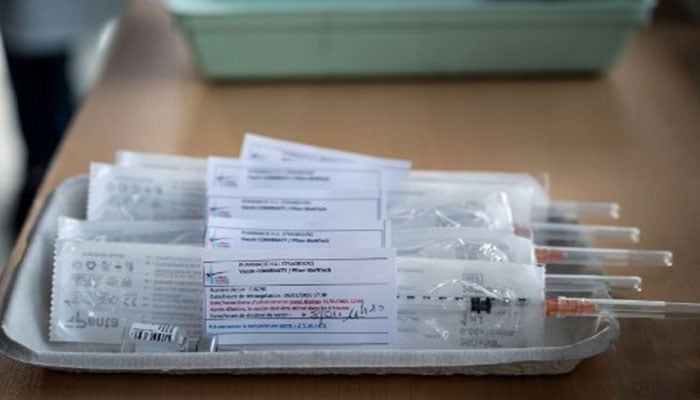
Meanwhile, the World Health Organisation warned on Tuesday there could be shortfall of up to two billion syringes in 2022, which threatens to hamper vaccine efforts globally is production does not improve. The shortages are the result of Covid-19 vaccine campaigns, with billions more syringes than normal being used worldwide, badly denting global supplies.
Lisa Hedman, the WHO’s senior advisor on access to medicines and health products, said as the supply of Covid-19 vaccine doses increases, the supply of syringes needs to keep pace. "We are raising the real concern that we could have a shortage of immunisation syringes, which would in turn lead to serious problems, such as slowing down immunisation efforts," she told reporters.
"Depending on how the vaccine uptake goes, it could be a deficit of anywhere from one billion to two billion." More than 7.25 billion Covid-19 vaccine doses have been administered globally, according to an AFP tally.
That’s nearly double the number of routine vaccinations given per year -- and twice the number of syringes required. In a related development, South Korea has reported a total of 28,293 breakthrough Covid-19 infections, which refer to the fully vaccinated people who were infected with the virus, health authorities said on Tuesday.
The number of those who were infected with the Covid-19 two weeks after the full vaccination stood at 28,293 as of Oct. 31, according to the Korea Disease Control and Prevention Agency (KDCA).
It equals to 85.5 in every 100,000 people who got fully vaccinated. As of Oct. 31, the number of the fully inoculated people was 33,108,428. It is known that people can be protected from the virus two weeks after being fully vaccinated.







-
 Kanye West's Last Measure To Save Bianca Censori Marriage As He Tries To Salvage Image
 -
 Kim Kardashian Finally Takes 'clear Stand' On Meghan Markle, Prince Harry
 -
 Christina Applegate Makes Rare Confession About What Inspires Her To Keep Going In Life
 -
 Patrick J. Adams Shares The Moment That Changed His Life
 -
 Selena Gomez Getting Divorce From Benny Blanco Over His Unhygienic Antics?
 -
 Meet Arvid Lindblad: Here’s Everything To Know About Youngest F1 Driver And New Face Of British Racing
 -
 At Least 30 Dead After Heavy Rains Hit Southeastern Brazil, 39 Missing
 -
 Courtney Love Recalls How ‘comparison’ Left Marianne Faithfull ‘broken’
 -
 Pedro Pascal Confirms Dating Rumors With Luke Evans' Former Boyfriend Rafael Olarra?
 -
 Ghost's Tobias Forge Makes Big Announcement After Concluding 'Skeletour World' Tour
 -
 Katherine Short Became Vocal ‘mental Illness’ Advocate Years Before Death
 -
 SK Hynix Unveils $15 Billion Semiconductor Facility Investment Plan In South Korea
 -
 Buckingham Palace Shares Major Update After Meghan Markle, Harry Arrived In Jordan
 -
 Demi Lovato Claims Fans Make Mental Health Struggle Easier
 -
 King Hospitalized In Spain, Royal Family Confirms
 -
 Japan Launches AI Robot Monk To Offer Spiritual Guidance