
US State Dept refutes reports of travel ban list
First group, including Afghanistan, Iran, Syria, Cuba and NKorea among others, would be set for full visa suspension
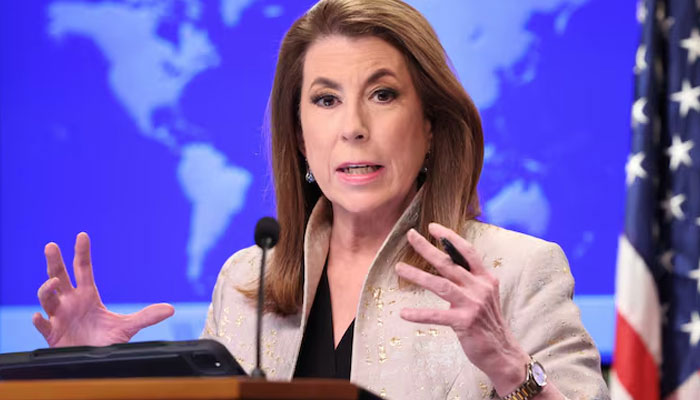
WASHINGTON: Amid much-hyped speculations concerning possible travel restrictions by President Donald Trump’s administration, the US State Department has ruled out the existence of any travel ban list.
“There is no list. What people are looking at over these last several days is not a list that exists here that is being acted on,” State Department Spokesperson Tammy Bruce said during a media briefing while responding to a question pertaining to Afghanistan’s status on the purported travel ban list.
The spokesperson’s rebuttal comes days after a draft list emerged provisioning the names of 41 countries — including Pakistan, Afghanistan, Iranm and others — divided into three separate groups which would be subjected to varying degrees of travel restrictions.
In the list, as per the memo seen by Reuters, Pakistan was included in a group that would be considered for a partial suspension of visa issuance if their governments “do not make efforts to address deficiencies within 60 days”.
The first group of 10 countries, including Afghanistan, Iran, Syria, Cuba and North Korea among others, would be set for a full visa suspension.
In the second group, five countries — Eritrea, Haiti, Laos, Myanmar and South Sudan — would face partial suspensions that would impact tourist and student visas as well as other immigrant visas, with some exceptions.
In the third group, a total of 26 countries including Belarus, Pakistan and Turkmenistan among others would be considered for a partial suspension of US visa issuance if their governments failed to address relevant deficiencies within 60 days.
A US official speaking on the condition of anonymity cautioned there could be changes on the list and that it was yet to be approved by the administration, including US Secretary of State Marco Rubio.
The move reflects the ban during the Trump’s first presidential term on travellers from seven majority-Muslim nations, a policy that went through several iterations before it was upheld by the Supreme Court in 2018.
Trump issued an executive order on January 20 requiring intensified security vetting of any foreigners seeking admission to the US to detect national security threats.
Expanding on the reports of the purported travel restrictions list, State Dept official Bruce said that there was a review, via President Trump’s executive order, for the administration “to look at the nature of what’s going to help keep America safer in dealing with the issue of visas and who’s allowed into the country”.
“But what has been touted as something that is an item through the State Department just simply isn’t the case,” she further clarified.







-
 Three Levels Of AI Leadership Every CEO Needs
 -
 ‘It's Time To Say Goodbye’: Gary Stevenson Pauses YouTube Channel Amid Mental Health Struggles
 -
 Japanese Football Legend 'King Kazu' Makes History With Goal At 59
 -
 Royal Expert Reflects On Prince William's Warning To Harry About Meghan Markle
 -
 'Frustrated' Meghan Markle Finally Distances Herself From Royal Title
 -
 US-Russian Space Crew Returns To Earth After Eight-month Mission On The International Space Station
 -
 Viking 1 Mars Landing: 50 Years Since First Photos
 -
 Prince Harry Feeling 'quite Hopeful' For Reconciliation With William: Here's Why
 -
 Lamine Yamal Strongly Warned About Romance With Girlfriend Ines Garcia
 -
 Lamine Yamal’s Girlfriend Ines Garcia Hits 4 Instagram Followers After Spain’s World Cup Win
 -
 US Sports Betting Nears $300 Billion As Experts Warn Of Addiction Risks
 -
 King Charles Takes 'huge Offence' To Prince William For Major Reason
 -
 ‘Fevered & ‘intellectually Challenged’ Prince Harry Sparks Worse Marital Problems With Meghan
 -
 Are We Closer To A Real-life ‘genie’ That Grants Any Wish: Here's What Sam Altman Thinks
 -
 Job Bon Jovi’s Mid-stage Exit Sparks Longtime Friend To Come Forward
 -
 Global Semiconductor Market Set To Pass $1tn In 2026