
Civilians military trial: Amended Official Secrets Act to apply retrospectively, SC told
Justice Rizvi says court wanted to know whether legal standards were adhered to during military trials of civilians
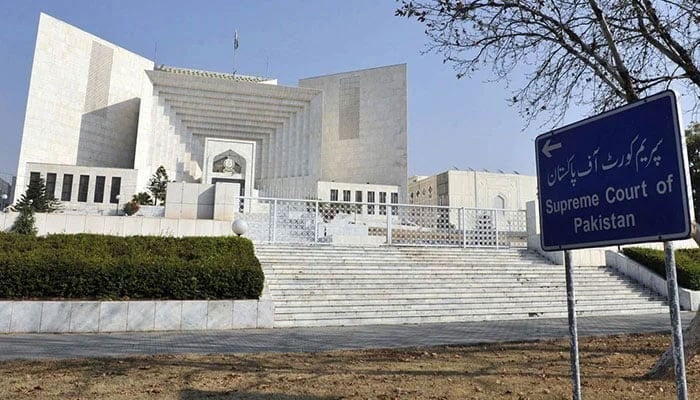
ISLAMABAD: The Supreme Court on Monday asked whether the recent amendments made to the Official Secrets Act would apply retrospectively, particularly to incidents of May 9.
A seven-member bench of the constitutional bench, headed by Justice Aminuddin Khan, heard the intra court appeals (ICAs) of the federal government as well as the defence ministry against the apex court judgment, declaring as unconstitutional trial of civilians in military courts.
Other members of the bench included Justice Jamal Khan Mandokhel, Justice Muhammad Ali Mazhar, Justice Syed Hassan Azhar Rizvi, Justice Musarat Hilali, Justice Naeem Akhtar Afghan and Justice Shahid Bilal Hassan.
Khwaja Haris, counsel for the defence ministry continued his arguments on Monday. Justice Aminuddin Khan asked the counsel to conclude his arguments on Tuesday (today). “You should keep your arguments limited to the question as to which cases were transferred to military courts and why,” the bench head told the counsel. Judges also asked various questions regarding fair trial in military courts as well as standard of evidence presented during the trial.
Justice Hassan Azhar remarked that the Official Secrets Act was amended on August 11, 2023, while the incidents occurred on May 23. “Whether the amended law could be applied, retrospectively,” he asked Khawaja Haris. The counsel replied that the amended law would apply retrospectively.
Justice Rizvi said the court wanted to know whether legal standards were adhered to during the military trials of civilians and whether the accused were given an opportunity to present witness in defence or not. “How we will come to know that all legal requirements were adhered to and there was no violation of law of evidence during the military trials of civilians,” Justice Rizvi asked Khawaja Haris.
The judge further asked the counsel when they did not see the judgment, if they could see the proceedings record. Khawaja Haris replied that he would tell the bench about the procedure adopted by the military court during the trial without mentioning the identity of a convicted person in the instant case, but the instant proceeding should not affect the trial as well.
Justice Aminuddin Khan told the counsel the Supreme Court, through the instant proceedings, would not affect the trails, asking the counsel to keep the record secured and if needed, they would ask for it as well.
Justice Rizvi asked the counsel about the standard of presenting evidence in the military trial. Khawaja Haris replied that before examining the standard of evidence, the SC should also take into account its right of jurisdiction of hearing the matter. “I can say with utmost respect that you cannot hear this case on merit,” Khawaja Haris replied to the judge.
Justice Muhammad Ali Mazhar asked whether the trial of all nominated accused in May-9 incidents were conducted collectively. Khawaja Haris replied that the trials were conducted separately.
Justice Musarat Hilali asked Haris as to whether there was punishment for any army officer who suspends the Constitution and further questioned if there is any penalty specified by the Army Act for such an offence.
Counsel for the defence ministry replied that Article 6 of the Constitution is very much clear, prescribing punishment for suspending the Constitution, adding that the Constitution prevails over all laws while the Army Act also addresses violation of oath.
Justice Mandokhel asked if the judiciary had validated martial law, adding that whether judges, who endorse unconstitutional actions, also fall under the scope of Article 6 of the Constitution.
Justice Muhammad Ali Mazhar cited the case of former military dictator Pervez Musharraf, wherein judges were initially named in the high treason case, but were later excluded. Justice Mandokhel observed that the Army Act mentions several crimes, all of which apply to military officers.
Khawaja Haris submitted that the trial of civilians falls under Section 31-D of the Army Act, which has constitutional recognition for military courts. He submitted that the Army Act would be seen in the context of sections 2d(1) and 2d(2) of Official Secrets Act.
Justice Mandokhel asked the counsel as to whether a civilian’s military trial was considered a court martial. Khawaja Haris replied that military courts conduct court martial. “We have to examine whose case will go to the military courts,” Justice Mandokhel remarked. Later, the court adjourned the hearing for Tuesday (today), wherein Khawaja Haris will continue his arguments.







-
 'Buffy' Star Nicholas Brendon's Death Case Takes Massive Turn
 -
 FKA Twigs Takes Legal Stand Against Ex Shia LaBeouf
 -
 ‘Progressive’ Kate Middleton Snubs Outdated Royal Etiquette
 -
 Kylie Kelce Explains Why She Avoids Raising Kids With 'silver Spoon'
 -
 Meghan Markle Is Above Royal Family ‘empty Threats,’ Says Insider
 -
 Anne Hathaway Opens Up About 'defeated' Feeling As Working Mom
 -
 Shamed Andrew Should Testify In Epstein Case As ‘act Of Service’
 -
 What Really Happened Before Nicholas Brendon Was Found Dead At Home?
 -
 Sarah Ferguson Branded ‘most Famous Missing Person’ In UK Right Now
 -
 Why King Charles Does Not Need A Driving License? Expert Reveals
 -
 Did Graham Norton Really Sign NDAs For Taylor Swift’s Wedding?
 -
 ‘Polite’ King Charles Treats Staff Better Than ‘boorish’ Andrew
 -
 Princess Beatrice's Husband Raises Eyebrows With Deleted Instagram Post
 -
 Dua Lipa 'snubs' Priyanka Chopra
 -
 Will Taylor Frankie Paul Still Get Her 'Bachelorette' Salary?
 -
 'Harry Potter' Returns: First Glimpse Of HBO's New Series