
Civil society demands interim govt halt arrests of refugees
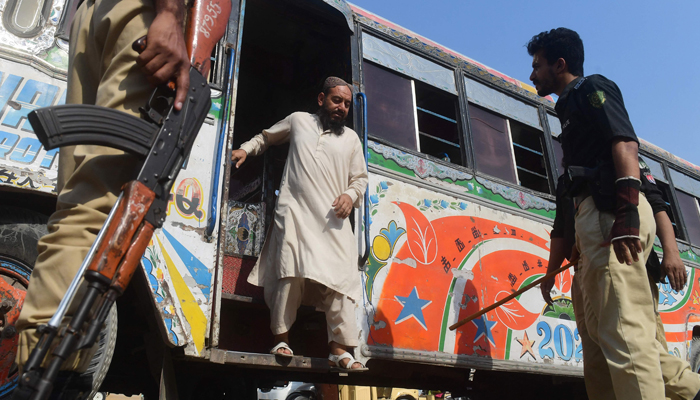
Fifty-six civil society members, including lawyers, professors, journalists, doctors, researchers and activists, have issued a joint statement to criticise the deportation of Afghan refugees and migrants from Pakistan, and to call upon the caretaker government to immediately halt the arrest of refugees.
The civil society members include Hina Jilani, Arif Hasan, Sheema Kermani, Dr Riaz Ahmad, Nida Kirmani, Mahnaz Rahman, Pastor Ghazala Shafique and Barrister Kazim Hassan. They said the interim government’s decision to uproot the lives of hundreds of thousands of people who have considered Pakistan their home and their country, where they have sought refuge from multiple wars and totalitarian regimes, is not only unconstitutional but also violates several international laws.
They claimed that the state is encouraging residents to give up the names and locations of Afghan families. “The state has opened up multiple detention centres where refugees, migrants and citizens are being refused their right to legal counsel and their right to spiritual support. Journalists have been barred from entering the detention centres.”
They pointed out that Pakistan’s constitution guarantees the right to a free and fair trial, prevention from torture, and the rights of the child. They said the constitution also maintains that no compulsory service would be of a cruel nature or incompatible with human dignity.
They said the Afghan people came to Pakistan fleeing multiple wars, economic and political instability, which are a threat to their lives. They came here for security, safety, to find home in a country that promised one, they added.
“The Pakistani state and the West must recognise their role in creating a disastrous human rights situation in Afghanistan now lasting four decades. We have turned our backs on refugees and migrants.”
However, they remarked, Pakistan is bound by certain principles of customary international law that govern the treatment of refugees. “As per the 1993 Cooperation Agreement with UNHCR, we are bound by the non-derogable principle of non-refoulement: the forced return of refugees to a country where they are at risk of persecution.”
They stressed that Afghanistan is currently under dictatorial and unelected Taliban rule. They pointed out that many of the refugees, migrants and citizens are Khwajasiras, Hazaras, Christians, human rights defenders, lawyers, journalists, artists, folk musicians and employees of the former Afghan government.
“All of these groups are at risk of near certain death if forced to return. Women no longer have the right to work or study in Afghanistan. By forcibly sending them back we will expose them to gross human rights violations.”
They said the civil society also recognises the rights of host communities and does not wish for any refugee to be a burden on them. It is possible to speak on the rights of refugees while also standing up for the rights of host communities, they added.
“The civil society calls upon the Government of Pakistan to facilitate refugees in a way that does not create divides between host and refugee communities.”
The most expedient way for Pakistan to do this is to introduce a Refugee Bill, which was last presented to Parliament this April, they pointed out. “As soon as elections are held in the country and a new parliament is sworn in, a Refugee Bill must be introduced, and the Foreigners Act of 1946 must be revisited. Pakistan also must become a signatory to the Geneva Convention of 1951 on the status of refugees.”
They said the civil society calls upon citizens of all countries to create a global movement for the rights of Afghan refugees. They demanded that the interim government immediately stop the “illegal” deportations and detentions of Afghan refugees and asylum seekers across Pakistan.
“POR cards must be renewed, and Afghans who fled the Taliban in August 2021 must be provided documents expediently. National human rights institutions including the NCHR, SCSW and NCRC must intervene to stop the enforced repatriation in order to practice their mandate to protect human rights.”
They also called for allowing a group of civil society, lawyers and journalists inside the “illegal” detention centres being set up by the caretaker government to document the rights of all those detained.
They said that a national legal framework for the protection of refugees must be developed and passed by an elected parliament. The state of Pakistan must ratify the Geneva Convention of 1951 on the status of refugees, they added.


