Pakistan today stands among the most populous nations in the world. According to the US Census Bureau’s 2025 Report, as of July 1, 2025, India tops the list with 1,419 million people, followed by China with 1,407 million, the US with 342 million, Indonesia with 283 million and Pakistan with 257 million. This demographic surge places Pakistan fifth globally, ahead of many developed nations with far stronger economies.
POPULATION GROWTH
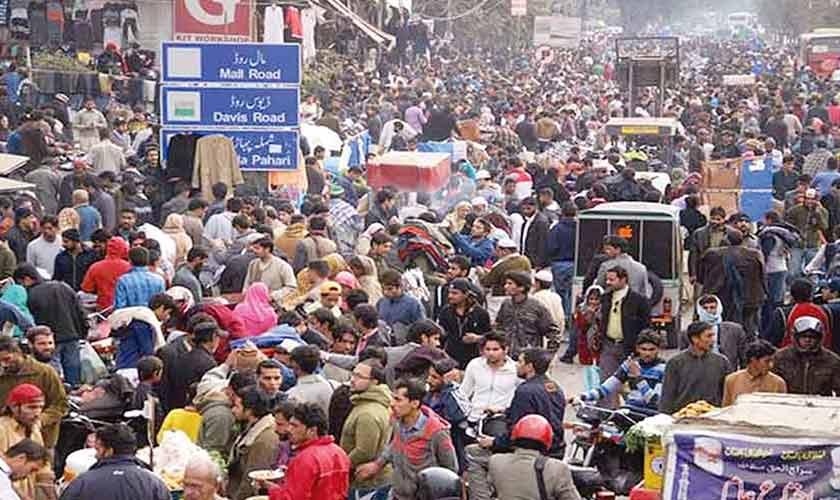
Pakistan today stands among the most populous nations in the world. According to the US Census Bureau’s 2025 Report, as of July 1, 2025, India tops the list with 1,419 million people, followed by China with 1,407 million, the US with 342 million, Indonesia with 283 million and Pakistan with 257 million. This demographic surge places Pakistan fifth globally, ahead of many developed nations with far stronger economies.
Over the past five decades, Pakistan has witnessed an extraordinary population growth. In 1972, the country had around 65 million people; by 1981, this figure had reached 84 million, 132 million in 1998 and 208 million in 2017 -- and an estimated 257 million in 2025. In total, around 192 million people have been added in just 53 years, nearly quadrupling the population. The UN projects that Pakistan’s population will climb to 450 million by 2050, which is substantially higher than the government’s own projection of 386 million.
These numbers are alarming when placed against Pakistan’s fragile socio-economic backdrop. According to the UN World Population Prospects Report 2024, there were 18,800 to 19,000 babies born a day in Pakistan, which translates into about 780 babies per hour. The economy has struggled with persistent poverty, a shrinking job market and sluggish growth. A fast-growing population directly depresses GDP per capita and per capita income, leading to long-term poverty traps. Already, Pakistan’s resources such as food, water, energy, housing, health and education are stretched thin, and the growing demographic burden only deepens the crisis.
On the other hand, unlike China, where population growth was effectively channelled into building a vast and productive workforce that boosted industrial growth and innovation, Pakistan has failed to convert its demographic surge into economic strength. Weak governance, poor family planning programmes and a lack of political commitment have dissipated what could have been a powerful human resource dividend.
The National Action Plan 2019–2024 aimed at managing population growth collapsed despite support from international organisations, NGOs and donor institutions. Earlier commitments in 2012 under FP2020 and now under FP2030 remain largely unfulfilled. A new National Health and Population Policy (2025–2034) is on the horizon, with objectives that are often repeated, such as integrating family planning into reproductive health services and raising awareness. Yet, without genuine political will, these initiatives are unlikely to achieve meaningful results. Even the proposed newly-created National Population Commission, chaired by the prime minister, risks irrelevance. Pakistan has seen similar commissions, such as the National Commission for Science & Technology, lapse into inactivity as its meetings have not been held in the past 15 years.
The crisis is not just about numbers. Pakistan’s human capital index, which is a measure of health, education and productivity, remains among the lowest in the world, sadly on par with Sub-Saharan Africa
Pakistan’s predicament stands in sharp contrast with other Muslim-majority countries in the region. Both Indonesia and Bangladesh have managed to control their population growth through consistent family planning policies. Bangladesh, the eighth most populous and most densely populated country, has reduced its annual growth rate to just 1.2 per cent, compared to Pakistan’s 2.6 per cent. Indonesia has lowered its annual growth to 0.8 per cent. Their economic performance reflects this: GDP per capita is $4,925 in Indonesia and $2,593 in Bangladesh, compared to just $1,581 in Pakistan. The impact is clearer when seen through per capita incomes: Indonesia, $3,189; Bangladesh, $2,159; and Pakistan, $1,470.
This divergence shows how better-managed population growth directly contributes to stronger economies and higher living standards. Both Indonesia and Bangladesh used extensive public education, community involvement, free contraceptive distribution and religious endorsement to shift societal norms toward smaller families. Bangladesh, in particular, is often cited by the World Bank as a model for Pakistan to emulate.
The crisis is not just about numbers. Pakistan’s human capital index, which is a measure of health, education and productivity, remains among the lowest in the world, sadly on par with Sub-Saharan Africa. Despite a young population, the country is failing to invest in education, healthcare, and skills development. The 2022 floods, and now again in 2025, exposed the fragility of Pakistan’s already weak human capital foundation, showing how millions remain vulnerable to climate shocks and poverty cycles.
Pakistan is at a tipping point. If present trends continue, the country will be home to nearly half a billion people by mid-century, with resources and institutions already under severe strain. High population growth is not just a demographic issue; it is the root cause of poverty, unemployment, food insecurity and economic stagnation. Family planning must be elevated to the highest national priority, backed by political resolve and effective implementation. Without decisive action, Pakistan risks undermining its future, locking generations into poverty and instability.
Yet there is still hope. The World Bank and the Asian Development Bank are committed to supporting Pakistan’s overall development, including family planning and public health initiatives, through various programs. The World Bank has already provided $100 million in 2023 to support family planning services in Punjab and has approved, in August 2025, a grant of $47.9 million to improve access to education for over four million children. The United Nations Population Fund (UNFPA) partners with the government to actively support the family planning programs and delivery services. These investments must be leveraged with genuine reforms, public awareness, and provincial ownership. The lesson from Indonesia and Bangladesh is clear: population growth can be managed and prosperity can follow.
Time is of the essence for Pakistan. The choice is rather obvious: either act now to harness its human potential or face an unsustainable population explosion that will cripple its economy and society for decades to come.
The writer is a retired chairman of State Engineering Corporation.