What next for Brexit as May wins leadership battle?
Her victory means she will continue to helm Britain´s exit from the European Union next March, and she will likely continue to press the bloc for concessions to sell her under fire withdrawal deal back home.
LONDON: What happens to the Brexit process now Prime Minister Theresa May has defeated Wednesday´s challenge to her leadership?
Her victory means she will continue to helm Britain´s exit from the European Union next March, and she will likely continue to press the bloc for concessions to sell her under fire withdrawal deal back home.
But the EU has repeatedly vowed not to budge and with less than four months before the date when Britain is set to leave the European Union, the path forward remains highly uncertain.
Here are some of the most probable scenarios:
Tweaks to the deal
May´s 200 to 117 win over her rebel Conservative MPs was closer than expected, but means she cannot face another no-confidence challenge from within her party for 12 months, giving her some breathing space as she attempts to tweak her deal and get it through parliament.
The British leader has said she still plans to bring her Brexit deal to a parliamentary vote some time before January 21, but Wednesday´s result shows the daunting task which lies ahead.
May held talks with European counterparts on Tuesday over the so-called "backstop plan" for the Irish border as she attempts to drum up support.
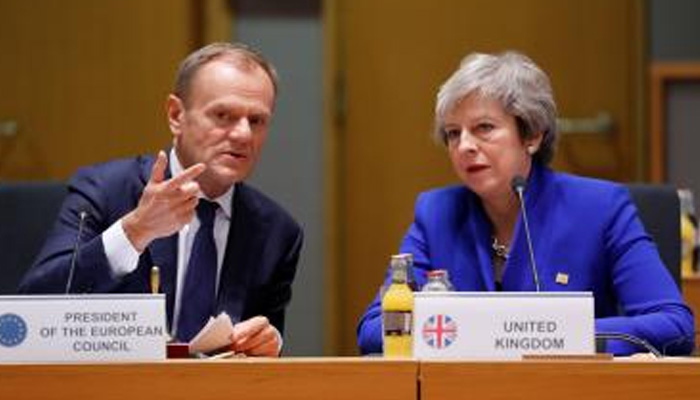
She will meet with European counterparts to discuss Brexit during a two-day summit in Brussels starting Thursday, seeking "political and legal assurances" over the backstop.
Bloc leaders have said only clarifications or tweaks in the accompanying declaration on post-Brexit ties might be possible.
Norway option
If May´s Brexit deal is rejected when lawmakers eventually vote on it, MPs are set to take more control over the whole process.
They could push for a "plan B", which would see Britain adopt a softer Brexit, such as staying in the EU´s satellite trading bloc the European Economic Area -- the so-called Norway option.
Although being in the single market would require maintaining freedom of movement of EU citizens into Britain -- a contentious issue for pro-Brexit voters -- this approach is considered more likely to command a majority in parliament and potentially pass a vote.
Another potential obstacle, however, is that Britain would have to continue paying large amounts of money into the EU budget, which would prove hugely unpopular.
No-deal Brexit
Britain is due to leave the European Union on March 29, 2019, after triggering Article 50 -- the treaty mechanism used to exit the bloc -- two years prior.
May has warned that if MPs vote down her Brexit plan the country risks crashing out on this date with no agreement.
That would sever ties overnight with Britain´s closest trading partner, amid fears of grounded flights, medicine shortages and gridlocked ports and motorways.
But many Brexiteers say they favour leaving the bloc in a "managed" no-deal with last-minute agreements struck in key areas.
Second referendum
Calls for a new referendum now attract cross-party support from dozens of MPs.
May has repeatedly ruled out a second public vote, but could face pressure to call one if Britain slips into political paralysis.
Supporters of a second referendum received a boost from the European Court of Justice on Monday, which ruled that Britain has the unilateral right to revoke its Brexit decision.
General election
The prime minister could try to break the parliamentary deadlock by calling a general election -- but would need the backing of two-thirds of all MPs.
Despite surviving Wednesday´s party vote, a simple majority of all lawmakers could topple her government with a vote of no confidence, with some opposition MPs on Monday calling for such a move in parliament.
But a Labour spokesperson said that the party would only submit such a motion "when we judge it most likely to be successful".
Losing a confidence vote tabled by the opposition could lead to the formation of a new government -- possibly a coalition of parties with a new leader -- if MPs can agree on it within two weeks.
Otherwise, a general election would be called.


-
 G7 moves to release 100 millions of barrels of oil 'immediately' after Trump threat
 -
 First radio emission detected from planet beyond our solar system
 -
 Nexus rules are changing for Americans and Canadian next year: Here’s what you should know
 -
 Man arrested after alleged death threats to Canadian PM Mark Carney on X
 -
 US Coast Guard seizes Cuba-bound ship carrying ‘large quantities’ of fuel
 -
 US urged to halt death penalty after Christa Pike’s failed lethal injection
 -
 Kennedy Center honors relocates to Capital One arena amid Trump naming dispute
 -
 Cornell student groups to protest university’s handling of alleged gang rape
-
 G7 leaders convene emergency talks on diesel crunch as UK forecourt prices hit £2 a litre: report
 -
New York governor slams Cornell police over alleged fraternity gang rape
-
France school protests to continue as students call for nationwide action
-
CNBC’s Rick Santelli says goodbye after more than 27 years on air