China, India agree to end Doklam stand-off, withdrawal of troops
NEW DELHI: China and Indian authorities have agreed to bring to an end a prolong stand-off at the Sikkim border that began in June, Indian government said Monday.
According to the Indian government, the breakthrough in the stand-off was reached by diplomatic talks between the China and India.
Indian Ministry of External Affairs, "On this basis, expeditious disengagement of border personnel at the face-off site at Doklam has been agreed to and is on-going."
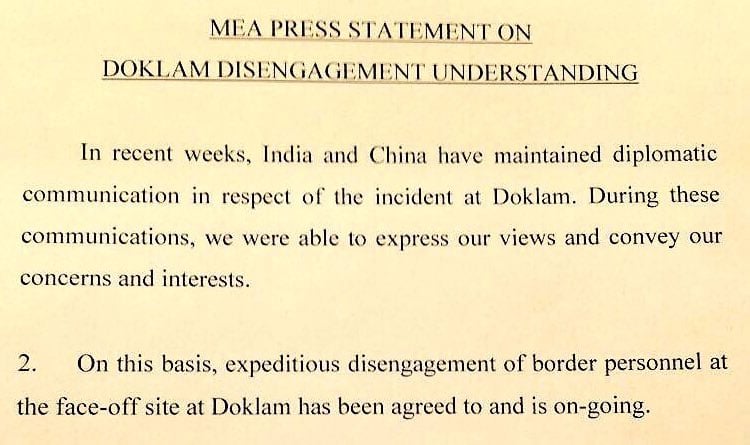
It added, “In recent weeks, India and China have maintained diplomatic communication in respect of the incident at Dokhlam, during these communications, we were able to express our views and convey our concerns and interests.”
The breakthrough comes ahead of Indian PM Narendra Modi's visit to China in a few weeks for a summit of the BRICS group of nations.
The conflict, which was the worst in decades, saw 300 soldiers from each side, confronting each other on the remote Doklam plateau in the Eastern Himalayas.
In June, Indian soldiers crossed the Sikkim border to stop China from constructing a road on the Doklam Plateau, which is disputed territory for Chin and Bhutan.
India has sided with Bhutan's claim.
Delhi had said that it had forewarned China that the road would be seen as a serious security concern because of the access it opens up to the narrow sliver of land called the "Chicken's Neck" that links India to its northeastern states.
China retorted that it had every right to build a road in a region that is part of its territory.


-
 FBI report reveals investment scams surged 87% in two years
 -
 Ex CIA officer charged over alleged theft of gold bars and public funds
 -
 Former judges challenge dismissal of Trump’s $10 billion IRS lawsuit
 -
 US Justice Department launches criminal probe into Trump accuser E. Jean Carroll
 -
 Jill Biden says Joe Biden’s 2024 debate left her fearing ‘he’s having a stroke’
 -
 US adds Iran shipping authority to sanctions list over Strait of Hormuz
 -
 Trump is now threatening to ‘blow up’ Oman over Strait of Hormuz dispute
 -
 Crude oil prices climb again after renewed US-Iran tensions