AI could help planes avoid climate-warming contrails: What to know
UK trial uses AI to combat climate-warming contrails from aircraft
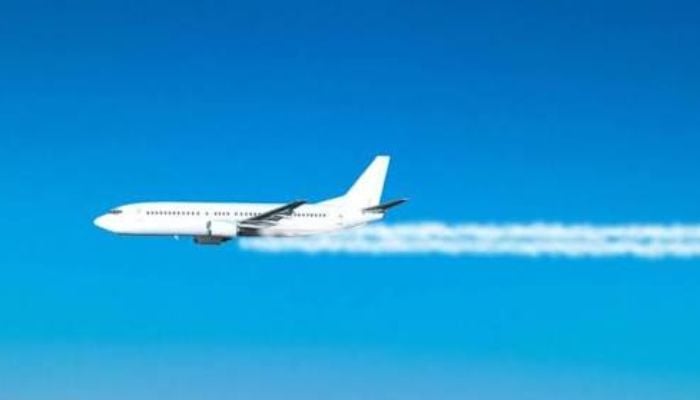
Artificial intelligence could help planes avoid creating climate-warming trails in the sky. Researchers in a recent breakthrough are exploring how AI can predict where these trails, known as contrails, are likely to form and guide aircraft around them.
For that purpose, a major £5m UK trail will test whether AI can help by predicting where they are likely to form. The primary focus will be on Shanwick Oceanic airspace in the eastern half of the North Atlantic corridor which makes up roughly 5% of global contrail warming.
Notably, the 30-month Operation Blue Skies project is designed to bring together Google, the UK government and researchers at the University of Cambridge and Imperial College London.
Contrails are also called vapour trails, and are made when the hot exhaust from an aircraft engine meets the cold air to create ice crystals.
Following the major discovery, Dr Paul Hodgson, Google’s technical lead for the operation said that his five-year-old has a more vivid description for the white lines called “ sky graffiti.”
In this connection, he said: “ We think that contrail warming is responsible for something like a third of all aviation climate warning.”
Dr Hodgson conceded ambiguity around the precise figure but confirmed scientists were confident it was either a major issue or a very large problem. The project also coincides with state support for growth of UK airports, pointing to a more extensive concern of whether tech solutions can mitigate aviation's impact during demand growth.
The prime motive behind the trial is that scientists can predict the atmospheric layers where contrails are likely to form and aircrafts avoid them.
Google will use satellite images and flight data to determine where plans have condensation trails. They are combined with a meteorological outlook to forecast where the conditions for new contrails are likely to occur.
Currently, the testing will take place during selected evenings and nights in the winters of 2026-2027. Meanwhile, 10,000 flights are scheduled to transit the airspace during the test, though only a fraction will need to alter altitude specifically to avoid contrails.
The results of Operation Blue skies are due to be released in academic literature and subjected to broader peer review.
According to Hodgson, previous trials indicated that the additional fuel consumption was significantly lower than the climate benefit of preventing a warming contrail.


-
 Can Europe wean itself off US rockets? Creotech CEO weighs in
 -
 Apple's iPhone Duo launch strategy was 'major mistake', Bloomberg’s Gurman says
 -
 WhatsApp tests new iPhone browser to open links inside app
 -
 Samsung to use TSMC's 3nm process for Nvidia's next-gen AI memory chips
 -
 Microsoft scraps UK data center project with Nscale ahead of IPO
 -
 TSMC, Apple eye 1.4nm chips as costs surge ahead of 2028
 -
 New plan would let Americans share in AI gains through stock accounts: Here's how
 -
 Missed iPhone Duo pre-orders? Apple Store walk-ins may be out of luck