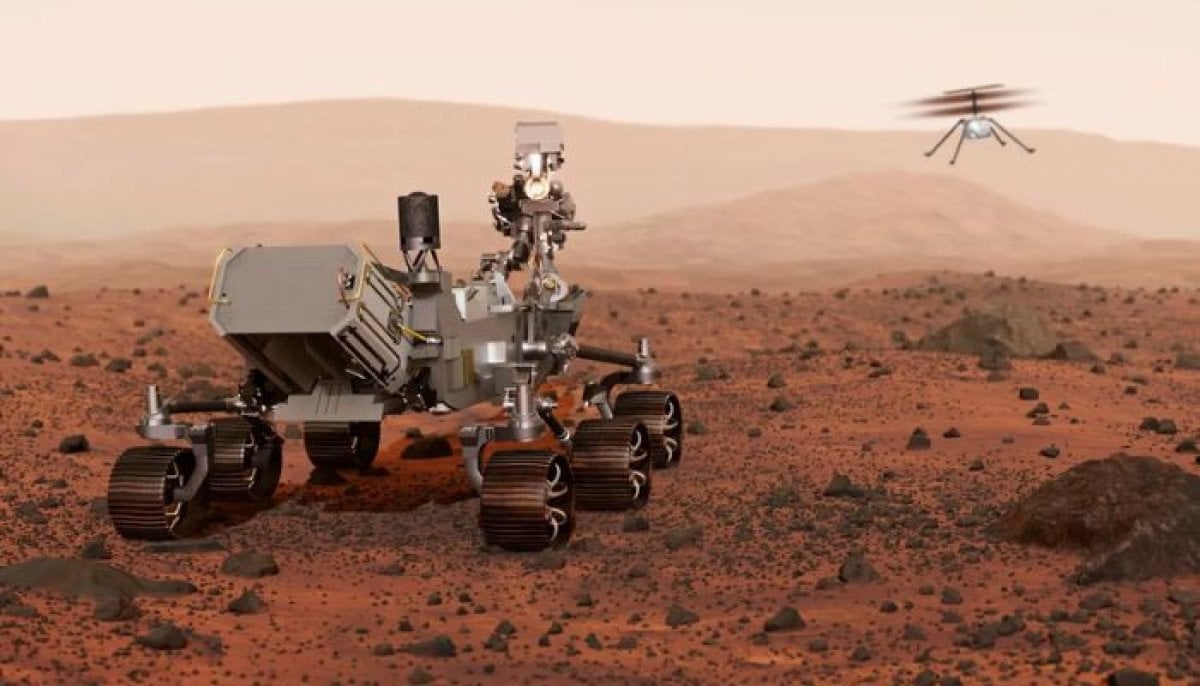
Scientists detect strange patterns that may signal alien life
Agnostic Biosignature approach will help scientists identifying planets which host alien life

Scientists in a recent breakthrough have introduced a new strategy to detect extraterrestrial life, marking a novel shift from relying on identifying specific biological markers.
According to a team led by Associate Professor Harrison B. Smith of the Earth-Life Science Institute (ELSI) at the Institute of Science Tokyo and Specially Appointed Associate Professor Lana Sinapayen, life beyond the Earth may be identified through patterns emerging across groups of planets.
This new approach named as “Agnostic Biosignature” will bring a paradigm shift in astrobiology where the determination of alien life is based on ambiguous and unreliable biosignatures, leading to false positives.
According to the study published in The Astrophysical Journal, agnostic biosignature methodology does not rely on information regarding existence of life and how it operates. Instead, this approach revolves around on two assumptions:
- First, life can move between planets through panspermia.
- Second, life can gradually alter the surrounding environments over time.
To test this hypothesis, researchers employed an agent-based simulation to model the panspermia-like spread of life across star systems and its subsequent impact on planetary evolution.
The findings revealed that as life spreads and modifies its environments, it develops statistically significant correlations between a planet's spatial location and its physical characteristics.
Notably, these large-scale "biological patterns" can be detected even if no individual planet provides a definitive, standalone biosignature.
Besides detecting the existence of extraterrestrial life, the researcher also developed a way to identify which planets are likely to host these traces of alien life. According to scientists, if we arrange the planets based on shared features and their position in space, it is possible to find the clusters shaped by biological activity.
Lana Sinapayen said, “Even if life elsewhere is fundamentally different from life on Earth, its large-scale effects, such as spreading and modifying planets, may still leave detectable traces. That's what makes this approach compelling.”
Although the recent study is based on simulations, the future research based on planetary data and realistic models will yield more productive outcomes.





-
 Scientists found 'super-puff' planets 1,110 light-years away
 -
 Scientists find ancient microbial life in places it shouldn't exist
 -
 Why Marijuana is suddenly sending thousands of dogs to hospitals in US?
 -
 36 years on, Hubble shows how stars actually change over time
 -
 Hidden magma beneath Mars? Scientists' 'unexpected' discovery raises new questions about alien life
 -
 Rare 3,200-year-old coral blue hole discovered in South China Sea
 -
 What happens at black hole’s event horizon? Scientists find the first-ever clue
 -
 Scientists discover evidence of fires used by humans 1.8 million years ago
-
 Did NASA just uncover evidence of ancient life on Mars? Key discoveries explained
 -
Four powerful earthquakes strike three continents within hours: Scientific link or coincidence?
-
Mysterious interstellar comet passing our solar system may be 12 billion years old, scientists say
-
When do we really become adults? Science has an answer