New autonomous robot outperforms human surgeons in ocular precision
A new autonomous robotic system is capable of performing delicate eye injections within the confined space of the human eye
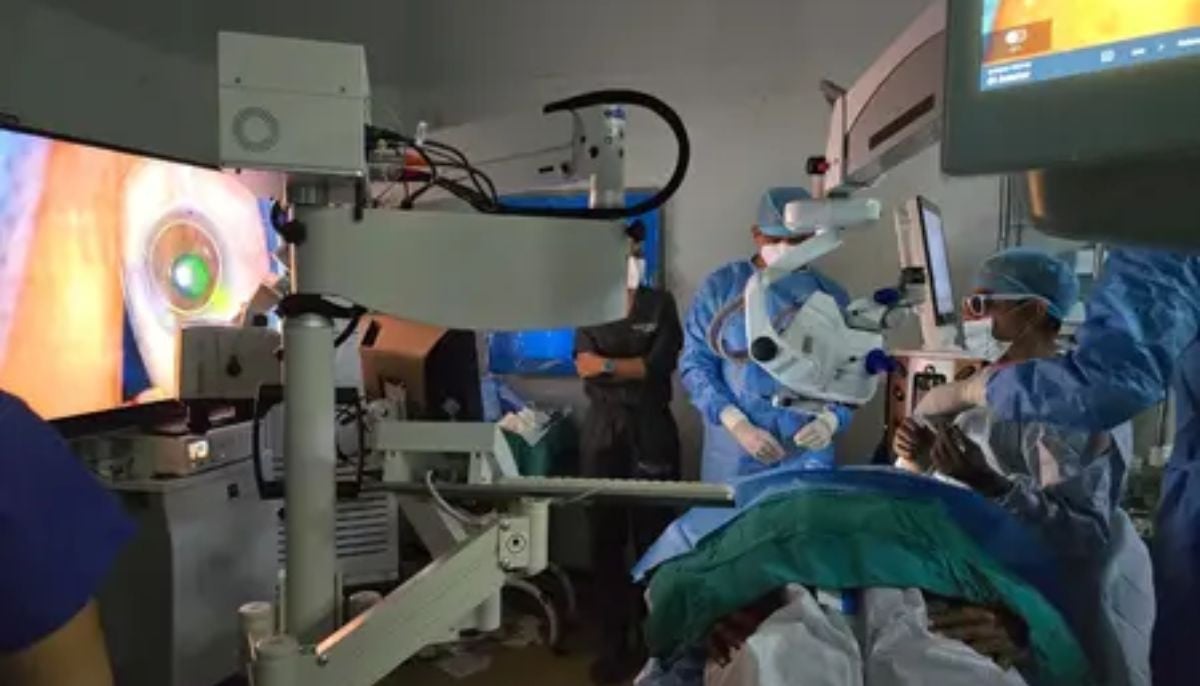
According to a recent groundbreaking study published in the journal Science Robotics by Chinese researchers, a new autonomous robotic system significantly outperforms human surgeons in ocular precision.
Developed by the Institute of Automation under the Chinese Academy of Sciences, the system demonstrated 100 percent success in delicate animal tests while performing both subretinal and intravascular injections.
Surgery on the eye is infamously challenging because of the organ’s small fragile tissues. The system overcomes this challenge by employing a distinct range of algorithms for 3D spatial perception, positioning, and trajectory control.
Further experiments using eyeball phantoms, ex vivo porcine eyes, and in vivo animal eyeballs revealed that the autonomous robot significantly mitigated the average positioning errors.
The study further demonstrated that the robot mitigated errors by nearly 80 percent compared to manual surgery. It was also observed that the system reduced positioning errors by about 55 percent compared to surgeon-controlled robotic surgery.
These results help establish the clinical feasibility of an autonomous intraocular microsurgical robot, underscoring its capability to enhance safety and consistency. Ultimately, such autonomous systems could improve outcomes in complex eye operations and are potentially effective for use in remote areas where specialists are unavailable.


-
 French parents underestimate children’s AI use, survey finds
 -
 China clears DeepSeek and MiniMax for global AI deployment
 -
 Greece's social media ban for children under 15 will take effect on January 1, 2027
 -
 What Is PHP, why is everyone talking about it?
 -
 OpenAI partners with Poland’s NASK to strengthen AI safety
 -
 YouTube custom feeds could finally fix your homepage
 -
 Japan plans cyberattack simulation as PHP vulnerabilities raise security concerns
 -
 WhatsApp reels shortcut adds 3 tabs: Recents, saved, liked