Could worsening South Atlantic Anomaly spell doom for life on Earth?
The growing weak spots in the magnetic field could cause serious repercussions
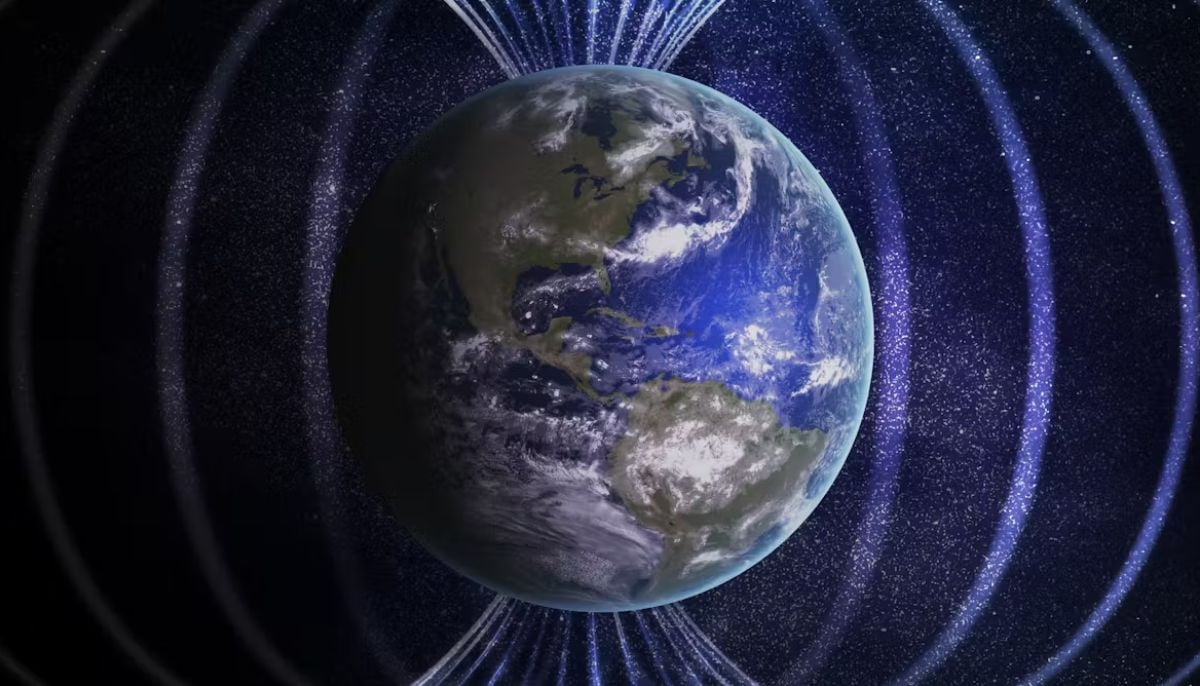
Scientists have warned of weakening of Earth’s magnetic field over the Atlantic Ocean, a region also called South Atlantic Anomaly (SAA).
As per researchers’ observations, the growing weak spot in the magnetic field could cause serious repercussions.
The Earth’s dynamic magnetic field plays an important role in protecting the planet from harmful radiation and promoting the survival of all life.
The magnetic field is produced by a global ocean of molten liquid iron, comprising the Earth’s outer core.
The scientists have detected the weak spots through more than a decade of measurements collected by three orbiting observatories.
The European Space Agency’s Swarm trio of satellites discovered that Earth’s already frail magnetic field over South Atlantic Anomaly (SAA) is exacerbating and has widened by an area half the size of Europe since 2014, as per new study published in Physics of the Earth and Planetary Interiors.
Another region over Canada also showed signs of weak magnetic field. However, as per measurements, the magnetic field over Siberia has strengthened.
_updates.jpg)
According to Chris Finlay, lead author of the study, “The South Atlantic Anomaly is not just a single block. It’s changing differently towards Africa than it is near South America. There’s something special happening in this region that is causing the field to weaken in a more intense way.”
As per researchers’ findings, Earth’s magnetic field is acting strangely due to distorted patterns in the boundary between Earth’s liquid outer core and its rocky mantle.
Beneath SAA, the magnetic field has strangely been witnessed to go back into the core, instead of coming out of it.
Scientists have sounded alarm over the shifting patterns in Earth’s magnetic field as these weak spots could spell doom for satellites and astronauts in Low Earth Orbit (LEO).
To make matters worse, these satellites could also undergo full blackouts, researchers warned in the study.
Moreover, in the case of a weak magnetic field, space explorers and spacecraft that enter the South Atlantic spot could be exposed to more cosmic radiation.
Astronauts who venture in Low Earth Orbit could face high health risks, such as cancer and DNA damage. “Astronauts will also experience these charged particles, but their times in orbit are shorter than the lifetime of most low-Earth-orbit satellites,” Finlay said.


-
 Halle Berry’s custody case: New voice may enter the courtroom
 -
 Charges Selma Blair may face over alleged conduct on Delta flight
 -
 'Breaking Bad' star RJ Mitte dies at 34
 -
 Katie Price takes the stand in ex-husband's trial
 -
 Prince Harry reveals his 10-day rule for Meghan and kids
 -
 Selma Blair arrested after 'assault' on two flight attendants
 -
 Royal family security to be reviewed after murder of ex-minister
 -
 Mikey Madison opens up about her Frances Haugen role