
Five killed in Indian-occupied Ladakh as protesters demand autonomy
Demonstrations organised in solidarity with hunger striker activist Wangchuk demanding Ladakh statehood
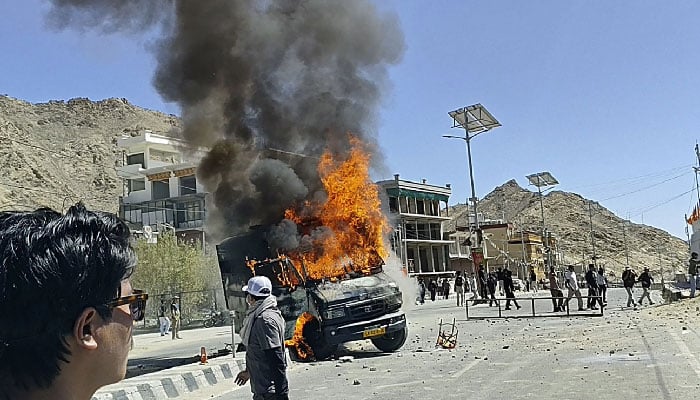
Clashes between police and demonstrators in Indian-occupied Ladakh on Wednesday left five people dead and dozens more injured during protests calling for statehood in the Himalayan region.
In the main city of Leh, demonstrators torched a police vehicle and the offices of Prime Minister Narendra Modi's Bharatiya Janata Party, while officers fired tear gas and used batons to disperse crowds, police said.
"Five deaths were reported after the protests," a police officer in Leh told AFP, on condition of anonymity as he was not authorised to speak to journalists. "The number of injured is in the dozens."
Another police officer, Regzin Sangdup, told AFP that "several people, including some policemen, were injured."
Authorities later imposed restrictions on gatherings, banning assemblies of more than four people.
The sparsely populated, high-altitude desert region, home to some 300,000 people, borders both China and Pakistan.
Around half of Ladakh's residents are Muslim and about 40% are Buddhist.
It is classed as a "Union Territory" — meaning that while it elects lawmakers to the national parliament, it is governed directly by New Delhi.
Wednesday's demonstrations were organised in solidarity with prominent activist Sonam Wangchuk, who has been on hunger strike for two weeks.
He is demanding either full statehood for Ladakh or constitutional protections for its tribal communities, land and fragile environment.
"Social unrest arises when you keep young people unemployed and deprive them of their democratic rights," Wangchuk said, in a statement posted on social media.
He appealed to people to avoid violence "whatever happens".
India's army maintains a large presence in Ladakh, which includes disputed border areas with China.
Troops from the two countries clashed there in 2020, leaving at least 20 Indian and four Chinese soldiers dead.
Modi's government split Ladakh off from Indian Illegally Occupied Jammu and Kashmir in 2019, imposing direct rule on both.
New Delhi has yet to fulfil its promise to include Ladakh in the "Sixth Schedule" of India's constitution, which allows people to make their own laws and policies.
"There is no platform for democracy here today," Wangchuk said. "Even the Sixth Schedule, which was promised and declared, has not been implemented."


-
 Can Keir Starmer’s successor stabilize UK markets amid rising pressures? Here's what to expect
 -
 Iran war could cost US taxpayers $1 trillion, expert warns
 -
 The frontrunners who could replace Keir Starmer as party leader and British prime minister
 -
 Philippine Senate lockdown after shots fired during ICC arrest attempt
 -
 Stephen Cloobeck, one-time Governor hopeful, arrested by cops
 -
 Iran war is shrinking global oil reserves at a record pace, IEA says
 -
 Another outbreak hits separate cruise ship after hantavirus panic
 -
 Trump just arrived in Beijing as all eyes turn to high-stakes China visit
-
 Savannah Guthrie sparks growing concern with major announcement: 'She's grieving, she's under pressure'
 -
Iran restores 90% of missile facilities after strikes, US intel says
-
A ‘total farce’: Kash Patel denies alcohol-related allegations, challenges Senator to drinking ‘audit’
-
Illinois case of hantavirus holds no link to MV Hondius cruise ship outbreak


