Chinese astronauts reach space station to conduct groundbreaking experiments
Three crew members blasted off into space aboard the Shenzhou-19 spacecraft from China's Jiuquan Satellite Launch Centre
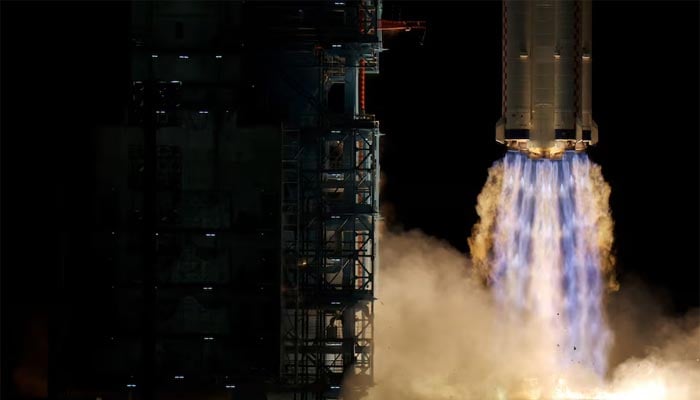
Three Chinese astronauts successfully docked at the nation's permanently inhabited homegrown space station on Wednesday, marking a significant milestone in its space exploration efforts.
The crew, led by 48-year-old Cai Yuzhe along with 34-year-olds Song Lingdong and Wang Haoze, reached the space station after a six-hour journey after launching into space aboard the Shenzhou-19 spacecraft, according to Chinese media.
"During the Shenzhou-19 flight ... 86 space sci-tech experiments will be carried out in the fields of space life sciences, microgravity physics, materials, medicine, new technologies," Lin Xiqiang, deputy director of the China Manned Space Agency (CMSA), said in a press conference on Tuesday.
The crew's mission includes conducting various scientific experiments as well as an experiment expected to involve exposing bricks made from simulated lunar soil to conditions in space for the potential construction of human habitats.
If successful, these bricks could serve as a key material used in the construction of a permanent lunar research station, which China hopes to complete by 2035, as it would in theory be more convenient than transporting building materials from Earth.
The bricks will be sent in a separate uncrewed cargo spaceflight to the Shenzhou-19 crew next month.
Additionally, Lin highlighted that, outside the mission, all three crew members are part of the Chinese military's air force, with Wang also being the third female Chinese national sent into space.
The Shenzhou crewed spaceflights have been a regular fixture of China's space program for the past two decades and have increased in frequency in recent years as China built and began operating its "Tiangong" space station, officially completed in November 2022.
The fast development of China's manned and unmanned space program has alarmed the United States, which has encountered issues with its own crewed spaceflights.
Two National Aeronautics and Space Administration (Nasa) astronauts brought to the International Space Station by Boeing's Starliner capsule in June have been stranded there since due to unforeseen issues with the spacecraft's propulsion system. They are expected to return in February 2025 on a SpaceX Crew Dragon spacecraft.
CMSA's Lin said that in order to avoid similar issues, the emergency response plan has been "continuously optimised" so that astronauts have more time to deal with scenarios such as damage to the Shenzhou-19 caused by space debris.
Lin added that Shenzhou-20 and its carrier rocket were on standby and ready to perform an emergency rescue mission if necessary.
The Shenzhou-19 crew is expected to return to Earth next year in April or May.


-
 Scientists name newly discovered snake after Guns N' Roses' Slash
 -
 SpaceX secures three new NASA crew flights: What to know
 -
 Sovereign AI fund in talks to back Political Sciences: What to know
 -
 What recent discovered Moon Crater Means for Future Astronauts
 -
 Scientists discover new wild cat species in Bolivia for the first time in a century
 -
 SpaceX turns to failed startups for AI training: Here’s why
 -
 Why US is preparing its troops for possible combat around moon
 -
 NASA finds ‘once-in-a-century’ moon crater bigger than Roman Colosseum