Einasto: Largest discovered galaxy supercluster can accommodate 26 quadrillion Suns
Universe's largest galaxy supercluster Einasto measures 360 million light years
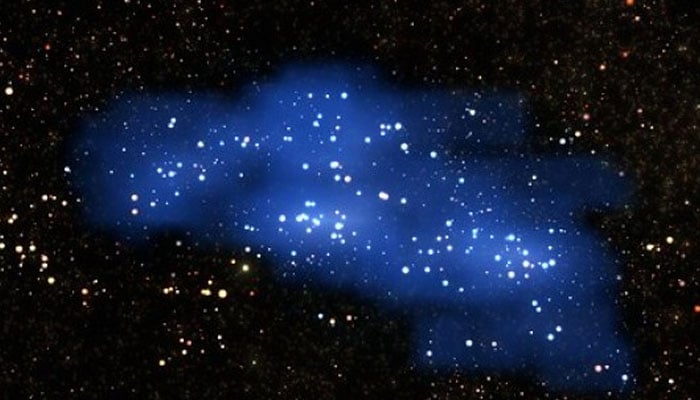
The newly discovered Einasto Supercluster which measures an incredible 360 million light years across is the largest structure in the Universe.
Einasto Supercluster is home to 26 quadrillion stars, according to Universe Today.
Superclusters like Laniakea and Einasto (which is 3 billion light years away) are among the largest structures in the Universe. This latest supercluster has been named after Professor Jaan Einasto.
He celebrated his 95th birthday on 23 February 2024 and was a pioneer in the field of superclusters.
Imagine an average coin on a football pitch to visualise the sheer size of these structures.
This coin portrays the Milky Way Galaxy and the length of the pitch would be the supercluster.
One can also imagine the Sun as a golf ball, whereas, the entire collective mass of the supercluster can be considered as Mount Everest in comparison.
It can be imagined that a light ray that begins its path at one end of the Einasto Supercluster will take 360 million years to reach its other end, in the light of these gigantic dimensions.
Galaxies in superclusters expand more slowly than in the universe as a whole, as per the researchers.
This phenomenon is caused by the gravitational pull of the supercluster.


-
 SpaceX ‘Space Junk’ is on a collision course with the Moon, scientists say
 -
 Do you know what happened on May 10, 1967? NASA's M2-F2 disaster explained
 -
 Why the Southern Ocean is melting: Antarctica’s sea ice resilience reaches a breaking point
 -
 Giant black holes are cosmic ‘Frankensteins’ built by mergers, new study reveals
 -
 NASA’s Artemis 2 moon launch becomes the largest event in Space Coast history
 -
 Is success written in your DNA? New study reignites nature vs nurture debate
 -
 Researchers found 240-million-year-old giant mysterious 'sand creeper'
 -
 New solar-powered process turns plastic waste into clean hydrogen
-
 Giant squid detected off Western Australia coast as deep-sea study reveals hidden species
 -
Astronomers discover unexpected atmosphere beyond Pluto on tiny solar system object
-
‘Evolution is not always random’: Study finds same gene reused for 120 million years
-
Real-life Tatooine moment: Astronomers discover 27 ‘Star Wars’ like planets orbiting two suns