Nasa unveils first-ever space-grown plant
Nasa envisions plant cultivation in space will help microgravity research and will also help astronauts with gardening management
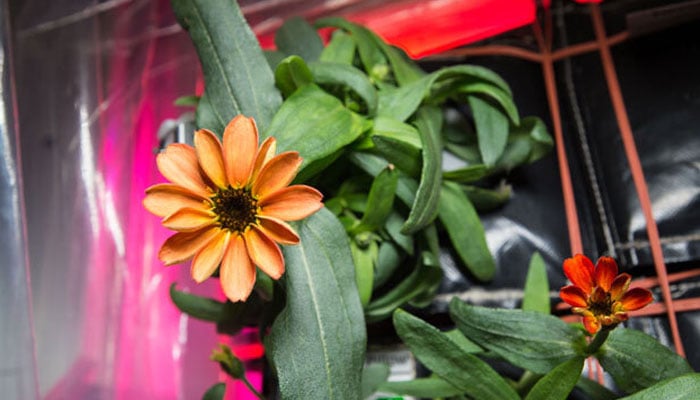
An image of a zinnia plant in space, the first-ever plant grown entirely in space, was made public on Tuesday, announcing their historical achievement.
Rapid advancements in space and frequent human visits to the International Space Station require understanding plant growth for long-distance food cultivation as far as Mars.
To make this possible, Nasa previously began cultivating flower harvests in space in 2015, when Nasa astronaut Kjell Lindgren turned on the Veggie system and its zinnia seed-filled rooting "pillows."
Today, almost eight years later, a picture of the zinnia plant that flourished on the International Space Station was made public by the US space agency.
While sharing the image of the zinnia plant, Nasa commented, "This zinnia was grown in orbit as part of the veggie facility aboard the International Space Station. Scientists have been studying plants in space since the 1970s, but this particular experiment was started on the ISS in 2015 by Nasa astronaut Kjell Lindgren."
Our space garden isn't just for show, Nasa said, underscoring the significance of the space garden.
"Understanding how plants grow in space will help understand how to grow crops on Earth, offering an important source of fresh food on long-term missions to the Moon, Mars, and beyond," the company noted.
Other than the plant, Nasa astronauts have successfully grown lettuce, tomatoes, and chilli peppers on the International Space Station (ISS), and they plan to grow other plants too.
Nasa claims growing zinnias provides researchers on Earth with insights into microgravity plant development and astronauts with autonomous gardening for deep space missions.
The image inspired a lot of science enthusiasts to express their enthusiasm in the comment section in large numbers.
"Two special things that come together are flowers and space. Thank you, Nasa," commented a user. Meanwhile, another user wrote, "Unbelievable and beautiful."


-
 Scientists discover alien-like systems shaping habitable planets
 -
 Japan ispace delays NASA-backed moon landing to 2030
 -
 Space babies: Can humans really reproduce beyond Earth?
 -
 Jupiter lightning proves far more powerful than Earth
 -
 NASA Artemis II moon mission ready to take off: Here’s everything to know
 -
 How dogs became man’s best friend 15,800 years ago: New study reveals
 -
 Real-life ‘Project Hail Mary’ moment: 45 planets that may support alien life discovered
 -
 CERN successfully transports antimatter for first time in historic breakthrough