Longest dinosaur neck was 10 times longer than a school bus
This long-necked sauropod, known as Mamenchisaurus sinocanadorum, lived approximately 162 million years ago during the Jurassic period
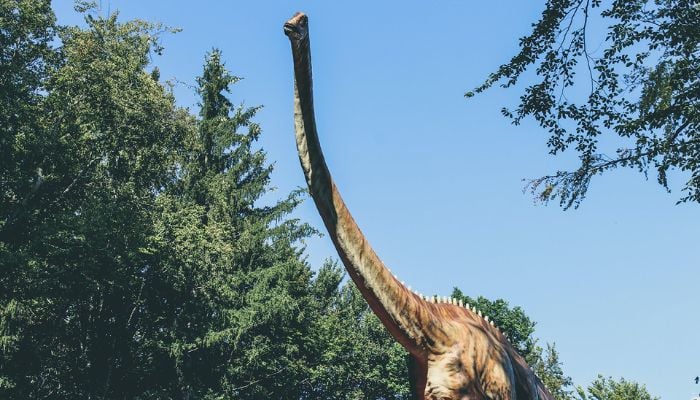
The longest-necked dinosaur ever discovered had a neck that was 49.5 feet (15.1 metres) long, according to a new research study.
That is approximately 10 feet (3 m) longer than the length of a school bus and more than six times the length of a giraffe's neck. According to the research, which was released on March 15 in the Journal of Systematic Palaeontology, this long-necked sauropod, known as Mamenchisaurus sinocanadorum, lived approximately 162 million years ago during the Jurassic period in what is now the Xinjiang Uyghur Autonomous Region of northwest China.
"The long neck of Mamenchisaurus sinocanadorum, like those of other sauropods, would have made the animal an efficient forager, able to graze on the huge volumes of browse necessary to fuel such a huge body before moving to the next vegetation-rich spot," study first author Andrew Moore, a palaeontologist at Stony Brook University in New York, told Live Science in an email.
The fossils of this giant were discovered by researchers in 1987 but they could not find much. They only discovered a few bones — some neck vertebrae, a jaw bone, and a few neck ribs. But these were enough to find out enough about the long-dead dino.
Moore added that while all sauropods had long necks, these dinos were unique with their extreme neck proportions.
After M. sinocanadorum, the next longest-necked dinosaur is Xinjiangtitan shanshanesis, a mamenchisaurid that boasts the most complete preserved neck on record at 43.9 feet (13.4 m), Moore said.
M. sinocanadorum evolved to maintain the strength and lightness of its enormous neck. Similar to the light skeletons of modern storks, a computed tomography (CT) scan of the dinosaur's vertebrae revealed that air made up as much as 77% of their volume. This sauropod, like other sauropods, had 13-foot-long (4-meter) ribs in its neck that were formed like rods and overlapped in bundles on both sides of the neck, the researchers discovered.
Mike Taylor, a research associate in the Department of Earth Sciences at the University of Bristol in the UK, called the new study "pretty exciting".


-
 Savannah Guthrie's major decision leaves her emotional and concerned
 -
 Louisiana man charged with impaired driving after hitting crowd celebrating Lao New Year
 -
 'Trump at Walter Reed hospital': health rumors prompt White House reaction
 -
 New Covid variant BA.3.2 spreads across US as experts stress vigilance
 -
 Savannah Guthrie receives secret message as search for Nancy continues
 -
 Daylight saving ends in Australia: When clocks go back in April 2026
 -
 China develops AI VF tools to raise birth rates
 -
 Vanessa Trump sparks fans reactions as she rejects rumours of rift with Tiger Woods
-
 Tragedy at Peru football derby: One dead, 47 injured in rally at Alejandro Villanueva Stadium
 -
Where Vanessa Trump stands with Tiger Woods amid DUI drama
-
NASA Artemis II moon mission captures stunning Earth images during historic lunar journey
-
Canadian citizenship new eligibility rules explained: who qualifies and what has changed