No new variants in weeks after China ended zero-COVID: study
China saw explosion of infections after lifting its strict pandemic measures from early December, sparking fears world's most populous country could become fertile breeding ground for new, more severe strains
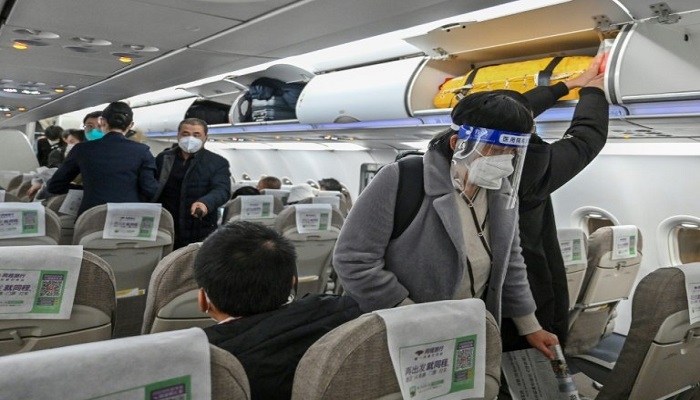
No new variants of COVID-19 emerged in Beijing in the weeks after China ended its zero-COVID policy late last year, a new study said on Wednesday.
China saw an explosion of infections after starting to lift its strict pandemic measures from early December, sparking fears the world's most populous country could become a fertile breeding ground for new, more transmissible or severe strains.
More than a dozen countries promptly imposed fresh restrictions on travellers from China, also citing a lack of transparency about the scale of the outbreak, sparking Beijing's ire.
But the new study by Chinese researchers, which analysed 413 samples from Beijing sequenced between November 14 and December 20, said "there is no evidence that novel variants emerged" during that time.
Instead, more than 90 percent of the cases were BF.7 and BA5.2, Omicron subvariants which were already present in China and have been overtaken by more transmissible subvariants in Western nations.
BF.7 accounted for three quarters of the samples, while more than 15 percent were BA5.2, according to the study published in The Lancet journal.
"Our analysis suggests two known Omicron sub-variants -- rather than any new variants -- have chiefly been responsible for the current surge in Beijing, and likely China as a whole," lead study author George Gao, a virologist at the Institute of Microbiology at the Chinese Academy of Sciences, said in a statement.
Wolfgang Preiser and Tongai Maponga, virologists at South Africa's Stellenbosch University not involved in the research, cautioned that it only covered a few weeks after China lifted its zero-Covid measures.
"If new lineages were to emerge in the course of the surge, the study was probably too early to find them," they said in a Lancet comment piece.
China has also dramatically cut back on its testing, potentially affecting the results, which also only cover Beijing and not the whole nation, they added.
However the virologists welcomed the "much-needed data from China".
"Although the fairly mild travel-related measures imposed by some countries for travellers from China once again might be viewed as punitive, one can but hope that this paper heralds more openness and prompt exchange of data going forward," they said.


-
 New personalized cancer vaccine cuts Melanoma recurrence risk by 42%, trial shows
 -
 Prime editing rewrites DNA inside human body for the first time
 -
 WHO investigates mystery Ebola case in Nigeria as outbreak spreads beyond DR Congo
 -
 Virginia Sen. Louise Lucas indicted on racketeering and marijuana charges
 -
 France confirms world's first human case of Shamonda virus; patient dies
 -
 OpenAI agents uncover brain disease leads: Here’s how
 -
 AI tool can now predict cancer survival by a single patient selfie: Find out how
 -
 Scientists identify a new type of depression affecting 1 in 4 patients
-
 Everything to know about US FDA’s new guidance on apps used with prescription drugs
 -
‘Immortal’ jellyfish could hold clues to slowing human ageing
-
Ebola crisis worsens in DR Congo as virus reaches eighth province with over 4,500 dead
-
Study finds eating blueberries every day can surprisingly boost your mood