
Pak-China agreement on Rashakai SEZ signed
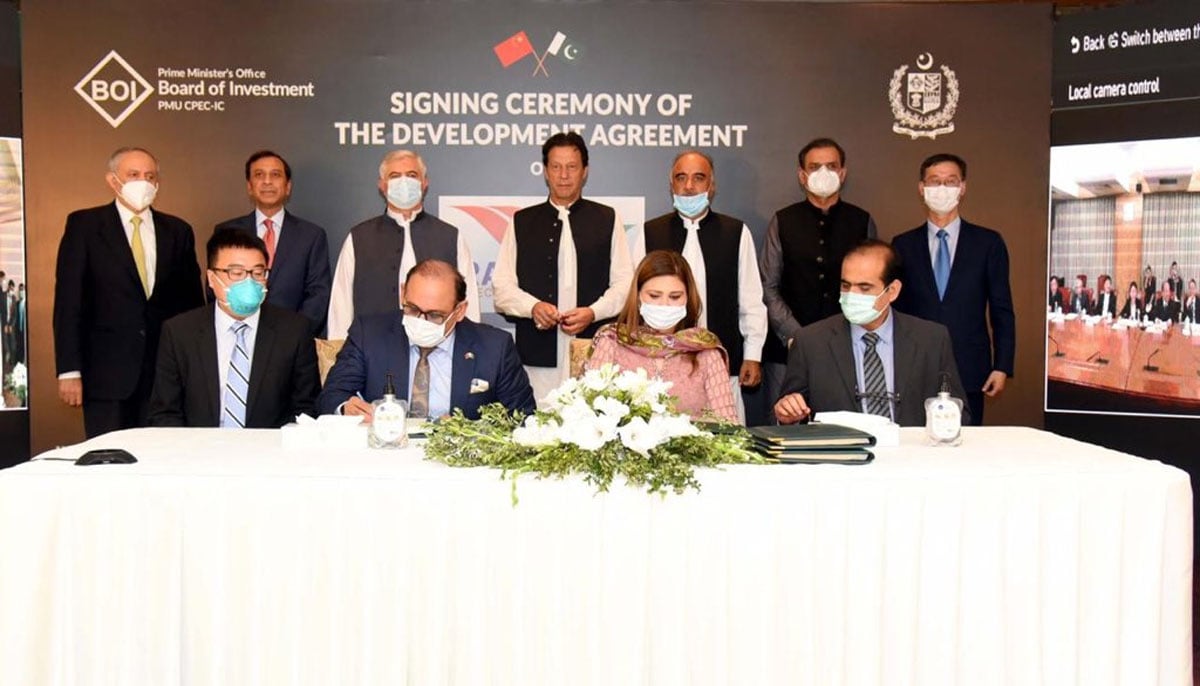
ISLAMABAD: Prime Minister Imran Khan Monday said it was the government’s top priority to provide jobs to the locals through promotion of industrialisation under the China Pakistan Economic Corridor (CPEC), being the next phase for progress and prosperity.
This he observed while addressing the signing ceremony of ‘Development Agreement of Rashakai Special Economic Zone’ (RSEZ). Prior to the address, he witnessed the signing of agreement between provincial government and the Chinese commission officials. Khyber Pakhtunkhwa Chief Minister Mahmood Khan, ministers, members of the National Development and Reforms Commission (NDRC) China, CPEC Authority and other relevant high officials were present during the ceremony.
Referring to the strategic position of Pakistan in the wider regional connectivity with the Central Asian countries, he welcomed the Intra-Afghan negotiations and called it a very significant achievement and said Pakistan had played a vital role in the Afghan peace talks and wanted them to sit together, as Islamabad wanted lasting peace for the regional prosperity and progress.
He maintained that if there were peace, it would lead to achievement of wider regional connectivity up to Central Asia. He said the deputy prime minister of Uzbekistan recently visited Pakistan and they were keen for laying a railway line via Mazar Sharif to Peshawar. Besides it, the prime minister said ML-1 would prove vital in the regional connectivity reducing travelling distance between different cities of the country manifold: It would also enhance the cargo activities, ease of doing and cost of doing business, being perhaps the biggest railway project in Pakistan’s history.
Under ML-1, he noted that the travel from Karachi to Lahore would be reduced to eight hours and from Lahore to Rawalpindi to two and a half hours and freight service would also immensely benefit from it.
Such a strategic location of Pakistan, the prime minister pointed out, would prove beneficial for the trade and business activities and especially the KP province, which had been on the frontline in the war on terror and gave immense sacrifices. He said the people of KP would get jobs at home who had been travelling to the Middle East and other cities of Pakistan for earning livelihood till now.
About CPEC, the prime minister said they were moving forward from communication linkage to industrialisation growth through agreements. “Our next phase is industrialisation. During 60s, the nationalisation drive had greatly impacted the country‘s economy and exports. However, nationalisation halted it and then there was de-industrialisation,” he contended.
Imran Khan said that the Chinese industry wanted to relocate, mainly because of cost of labour while Pakistan offered very attractive environment and the government would incentivise them as well as the local industry.







-
 Angelina Jolie, Brad Pitt's Daughter, Shiloh Makes Surprise Music Video Debut
 -
 ‘Very Angry’ Sarah Ferguson Finally Willing To Sell Out The King & Firm?: Inside Revenge Plans
 -
 Blac Chyna Escalates Legal Battle With Multi-million Dollar Cross-complaint Against Twin Hector
 -
 Meghan Markle Reacts To Patrick J Adams 'jam' Complaint
 -
 Why Attorney Says Justin Baldoni 'not Off The Hook' Despite Court Ruling? Report
 -
 'Abuses' Shouted At Andrew Mountbatten-Windsor As Protesters Breach Security
 -
 Jenna Dewan Reveals Mindset She Follows When Life Gets 'nuts'
 -
 Erika Kirk Dating Claims Surface As She Reclaims Charlie Kirk's Legacy
 -
 Karoline Leavitt Joins Erika Kirk At Washington Event
 -
 Lizzo Reveals Major Update About Her Sobriety Journey
 -
 Princess Beatrice’s Husband Edo ‘questioning Marriage’: ‘His Standing & Status Is Impacted’
 -
 Petition To Strip Blake Lively Of 'It Ends With Us' PGA Credit Gains Massive Support
 -
 New Development In Blake Lively Lawsuit After Judge Dismisses Major Claims
 -
 Blake Lively, Taylor Swift Texts Resurface After Court Ruling
 -
 Prince Harry’s Behavior Towards Queen Elizabeth Gets Exposed: ‘He Drove Her To Paranoia’
 -
 Blake Lively, Justin Baldoni's Legal Case Receives Latest Update