
Some UNSC members ignoring broader reforms, seeking privilege: Pakistan
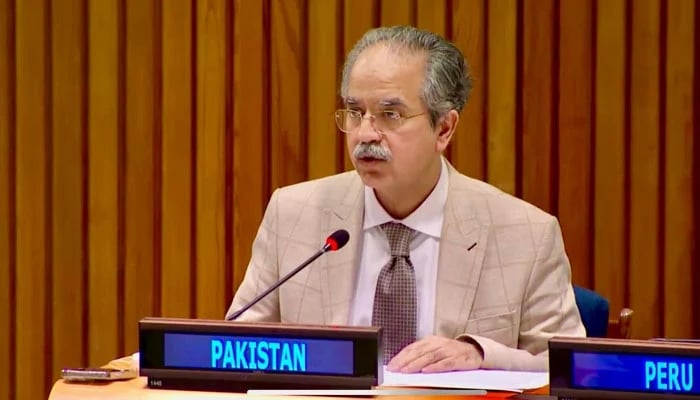
ISLAMABAD: Pakistan’s Permanent Representative to the United Nations Ambassador Asim Iftikhar Ahmad on Wednesday took to task a few member states of the UN Security Council who, he pointed out, were not looking into reforms for all member states but instead were seeking privilege for some which was creating the biggest roadblock to reforms.
The five permanent members of the UNSC are China, France, Russia, the United Kingdom and the United States. These nations were granted permanent seats with veto power in the UN Charter of 1945.
Ambassador Asim was making a statement at the GA Plenary on the question of equitable representation and increase in the membership of UNSC and other matters related to the Council.
“The reform of the Security Council involves vital interests of all UN member states, and must, therefore, be decided by the widest possible support of the UN membership i.e. by consensus,” he said.
The ambassador did not mince his words in pointing out that the inability to reach agreement on the reform does not stem from flaws in the reform process itself, but rather from the position of a few member states unwilling to accommodate the broader interests and perspectives of the wider UN membership. “So, instead of a reform for all, they are seeking privilege for some. Now that is the biggest roadblock to reforms,” he said.
Pakistan’s stance remains that concepts of permanency, privilege and special status should have no place in today’s United Nations. The reform of the Council should, therefore, enhance the voice of all UN member states.
Finding a way forward, the ambassador advocated that an acceptable formula with an increase in the non-permanent members and fair rotation through regular elections can provide more equitable representation for all states on the Council.
Making a case for a neglected Africa, the ambassador stressed that historic injustice against Africa must be redressed as provided for in the Pact for the Future. “Similarly, adequate representation of the underrepresented and unrepresented regions and groups, such as Asia-Pacific and Latin America and the Caribbean, as well as the cross-regional groupings such as the SIDS, Arab Group and Organisation of Islamic Cooperation (OIC), has to be catered for as also agreed in the Pact for the Future,” he said.
Pointing to Europe, he said that it enjoyed unequal advantage in the current composition which merits corrections.


