
Rethink the climate transition
As someone committed to climate action, I believe deeply in the urgency of decarbonising our world. But I also know that for countries like Pakistan, the path to sustainability cannot come at the cost of survival.
In today’s race towards net-zero, Pakistan is being asked to sprint before it can even walk – expected to decarbonise, expand industrial exports and eradicate poverty all at once. The country faces an impossible expectation that exposes the deep flaws in the current global discourse on a just transition. The current global model for just transition often fails to account for the complex economic and social realities of developing nations. It risks turning climate justice into an empty slogan which only asks the poorest to sacrifice the most.
Unlike the Western economies that industrialised on the back of fossil fuels or China, which grew before its environmental reforms, Pakistan is being asked to green its economy without the historical wealth, infrastructure or policy space others enjoyed. Simply adopting best practices from developed nations overlooks the critical fact that solutions cannot be copy-pasted when histories are not, and much of the global climate playbook is based on what worked for developed economies or China after decades of rapid growth.
Those models don’t fit Pakistan’s current stage of development. We cannot afford to shut down polluting sectors overnight nor can we import expensive green technologies at scale without undermining our economic foundation.
Take our energy transition as a case in point. Pakistan has experienced a significant increase in solar installations, with an estimated 17 gigawatts installed in 2024 alone. But this boom has brought more complications than capacity. Our grid, outdated and overburdened, cannot absorb this surge, while poor households are left covering the costs through cross-subsidised tariffs.
At the same time, soaring interest rates and currency devaluation have pushed renewable electricity prices to over rupees 40 per unit, making clean energy more expensive and less accessible to the very people it was meant to benefit.
This tension between ambition and affordability is not isolated. It mirrors our broader development paradox and the lesson is clear for us in this that climate leadership must be adaptive and not perspective and for that Pakistan need space to innovate our own models of transition, one that reflects both environmental urgency and economic reality and Pakistan’s economy hinges on industries like textiles and agriculture which are although emissions intensive but also labor intensive and are lifelines for millions.
Transitioning these industries without international trade adjustments or supportive global financing mechanisms would not only threaten jobs but also push our exports out of global markets, leading to economic disaster. Greener production raises costs, yet without mechanisms like preferential market access for sustainable goods, Pakistan’s exports would lose competitiveness to nations still operating cheaply and polluting.
Abrupt green reforms without economic cushioning can destabilise nations, and we cannot afford to get this wrong. Sri Lanka’s 2021 fertiliser ban, intended to green agriculture, instead devastated harvests and triggered a huge economic collapse. That short-lived agricultural revolution raised a critical question: Can a country realistically undergo a complete transformation on a national scale? Pakistan cannot afford to make this mistake, considering environmental ambition must be phased and economically grounded, and not rushed for international approval and validation.
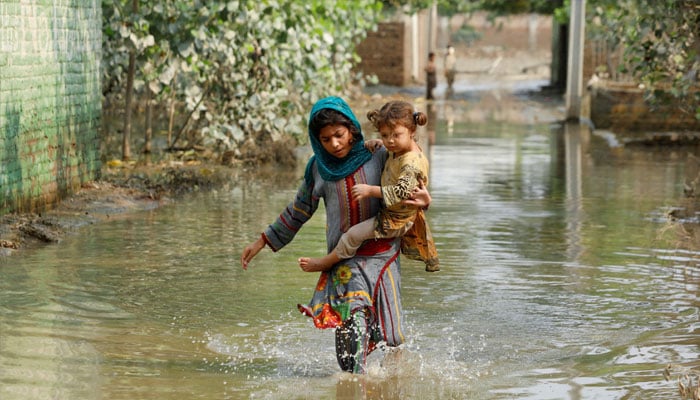
None of this is to suggest that Pakistan should delay climate action. Our vulnerability to climate disasters, from floods to droughts, makes climate action a national imperative. But the solution can never be to comply faster, but to build smarter and structurally.
Pakistan’s leadership should not merely seek climate funding, but also challenge and reshape the very frameworks defining transition fairness by advocating actively for climate-aligned trade through preferential access for sustainably produced goods from developing countries, real grant-based climate financing and subsidised transitional technologies
If the global community genuinely seeks an inclusive green future, it must recognise that for nations like Pakistan, survival and sacrifice cannot be treated as synonyms. For those of us working inside the climate space, we must push for equity with the same urgency as we push for emission cuts.
Without justice, there is no true transition, and without Pakistan and countries like it on board, there is no global solution.
The writer is an environmental engineer and the founder of ClimaTea, currently serving as a Climate Change Development Fellow at the Ministry of Planning, Development and Special Initiatives. She can be reached at: hadiatariq199@gmail.com


