
Built to collapse
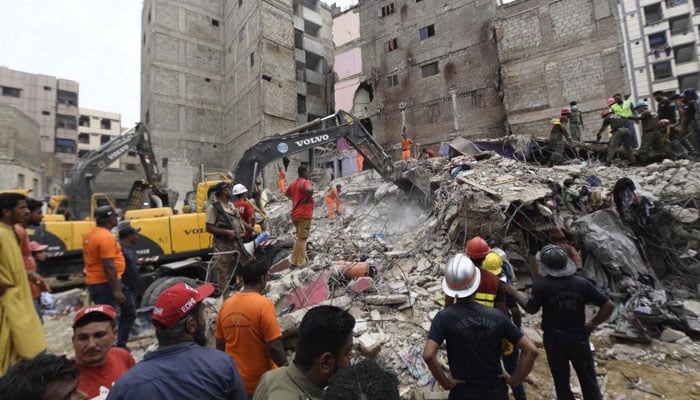
The death toll from the recent collapse of a five-story residential building in Karachi’s Lyari neighbourhood now stands at 27. To say that this is tragic and unfortunate would be an understatement.
The Sindh government has suspended the director general of the Sindh Building Control Authority (SBCA) following the tragedy, albeit belatedly. The mere suspension of the head of the SBCA, whose primary task is to ensure that buildings are not constructed in violation of codes and regulations, thereby ensuring the safety of residents, will not prevent further such tragedies from occurring.
The statement made by Sindh’s Senior Minister Sharjeel Memon at a press conference, that the government cannot possibly provide housing to all those who live in dilapidated and unsafe buildings, was rather insensitive. The pressing challenge right now is to prevent such collapses and the deaths they cause from happening. That means the SBCA should do its job properly and not allow buildings to be constructed in violation of building codes and regulations.
The one that collapsed in Lyari was reportedly built on a plot of just sixty square yards and had five floors. It shouldn’t have been allowed to be built in the first place. So the issue isn’t how many people currently residing in unsafe buildings can be given government housing, but to assign responsibility for what has happened to the officials who allowed this to happen. The punishment should be commensurate the scale of the tragedy.
That is what needs to be done first, in the short term. The focus of the government should be on that. In the medium and long term, the SBCA should be cleansed of all officials who, over the years, have either looked the other way and allowed such illegal structures to be built or have been willing accomplices in what is, in effect, criminal activity – in exchange for bribes, of course.
The issue relates not only to dilapidated buildings, which may imply that they were built many years ago, but also to recently constructed structures that were built in violation of building codes and regulations. In Karachi in particular, both categories are present. There are many buildings from the colonial era that are unfit for living, but where families reside, mainly because they cannot afford to move elsewhere.
Following the Lyari tragedy, the Sindh government has stated that across the province, over 700 buildings are in a dilapidated condition, and more than 50 are extremely hazardous to live in. It said that a deadline of forty-eight hours had been given to the residents of such buildings to vacate and that some of the ‘most deserving’ would be provided with temporary accommodation.
The Sindh senior minister also stated that there was no law obligating the government to provide housing to those living in such structures. While that may be true, there is a law that obligates the government to ensure that the housing structures that people live in are safe enough for them not to be killed or injured. And that is where the Sindh government has failed and fallen miserably short in fulfilling its responsibility of ensuring a system where rules and regulations are implemented in the construction of new buildings.
The unfortunate fact is that this is not a new issue. Successive governments over the years have ignored the corruption and inefficiency rampant in the municipal agencies under their control, such as the SBCA and the Karachi Water and Sewerage Corporation, both of whom by their acts of commission and omission are responsible for the poor quality of life of a large chunk of Karachi’s population.
The reason for this is due to political interference, where government organisations and bodies are used by political parties to reward party loyalists and supporters by providing them with jobs in these agencies. When that happens, the loyalty of the appointee is not towards the job, which is to provide reliable and efficient civic services and amenities to tax-paying citizens, but to the political party which facilitated their appointment. The result is that citizens end up losing out, and the provision of basic services and amenities is severely compromised, so much so that we have people living in what are nothing but death traps, as happened in this particular instance.
What needs to be done to clear up this mess – and it will not certainly be done overnight – is for those in government to empathise with the plight of ordinary citizens and to exhibit the political will needed to improve the quality of their lives.
The writer is a journalist based in Karachi. He tweets/posts @omar_quraishi and can be reached at: omarrquraishi@gmail.com


