
Pakistan eyes health sovereignty through local vaccine, medicine production: Mustafa Kamal
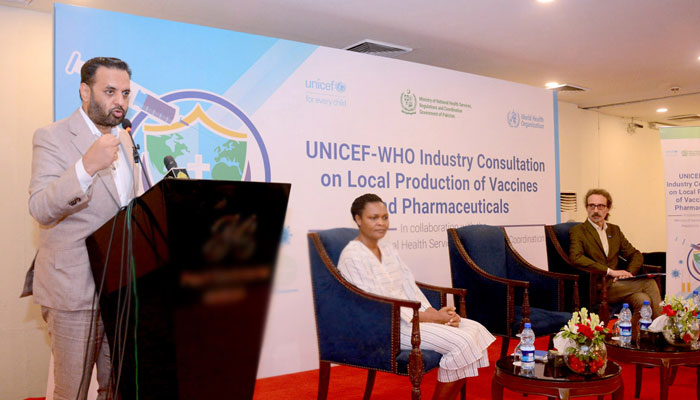
In a bold push for health sovereignty, Federal Minister for Health Syed Mustafa Kamal on Thursday announced the government’s firm resolve to scale up local production of vaccines and medicines, citing recent geopolitical tensions and supply chain disruptions as a wake-up call to reduce Pakistan’s dependency on pharmaceutical imports.
Addressing the closing session of the "UNICEF-WHO Industry Consultation on Local Production of Vaccines and Pharmaceuticals" in Karachi, the minister said the initiative marks a crucial step toward building a resilient and self-reliant health system in Pakistan.
“This consultation is not just an event—it marks a turning point in our journey toward health sovereignty,” he said and thanked UNICEF’s Abdullah A. Fadil and WHO’s Ellen Thom for their sustained support and commitment to strengthening Pakistan’s healthcare infrastructure.
“We have the talent, the capacity, resources, and now the urgency to locally produce the medicines and vaccines our people need,” the minister stated. He referred to recent regional tensions—particularly with India—that severely impacted the import of pharmaceutical raw materials, underlining the urgency of domestic manufacturing.
“In light of recent tensions with India, we’ve faced severe difficulties sourcing raw materials. This has made it clear—Pakistan must become self-reliant. With the guidance of WHO and UNICEF, we are ready to build that capacity,” Kamal asserted.
He also highlighted ongoing government efforts to support this shift, including regulatory reform. “I am personally overseeing reforms to strengthen the Drug Regulatory Authority of Pakistan (DRAP) and align our standards with global best practices,” he said.
The minister urged the pharmaceutical industry to embrace innovation, invest in research and development, and adopt international quality standards. “You are the architects of this transformation,” he told industry leaders. “We encourage you to pursue partnerships that bring in foreign investment and foster technology transfers. Together, we can turn Pakistan into a hub of pharmaceutical excellence.”
He further emphasized that with the right investments, strategic partnerships, and regulatory support, Pakistan could not only meet its domestic healthcare needs but also emerge as a regional exporter of pharmaceuticals and vaccines. “We have the infrastructure, talent, and strategic geographic position to become a key player in the global pharmaceutical supply chain,” Kamal said.
“Our goal is not just self-reliance, but excellence—where medicines manufactured in Pakistan are recognized and trusted across international markets,” he added. The two-day consultation, jointly organized by UNICEF and WHO, brought together key stakeholders including representatives from DRAP, the National Institute of Health (NIH), pharmaceutical manufacturers, healthcare institutions, and academic bodies to chart a roadmap for sustainable local pharmaceutical production.







-
 Dakota Johnson And Tucker Pillsbury 'romance': When Did Their Love Story Begin?
 -
 Princess Beatrice, Princess Eugenie Drawing ‘clear Blue Water’ With Royals
 -
 Luke Combs Knew His 2016 Song Would Make Him Superstar
 -
 Prince William, Kate Middleton ‘mean Business’ As They Prepare For Kingship
 -
 Johnny Depp's Trump 'prophecy' Leaves Fans Divided
 -
 Shamed Andrew Should Go To ‘bailiffs’ Over His Blunders
 -
 New Poll Results On King Charles US Visit Revealed
 -
 'Trump At Walter Reed Hospital': Health Rumors Prompt White House Reaction
 -
 Blake Lively's Apology To Kate Middleton Resurfaces
 -
 'Vampire Diaries' Star Candice King Marries 'The Originals' Actor Steven Krueger
 -
 JoJo Siwa Gets Candid About Marriage Plans
 -
 Dakota Johnson, 36, Confirms Romance With Role Model, 28, After Breakup With Older Boyfriend
 -
 Shamed Andrew Only Visited By THIS Family Member Amid Exile
 -
 King Charles Could Get ‘golden PR Points’ If He Fixes Harry Issues
 -
 Kristin Cavallari Weighs In On 'silly' Life As The Famous Mum Of Three Kids
 -
 Lauren Conrad Spills The Beans On Sons' Views About Her Fame