
Price of four-week Pakistan-India conflict pegged at $500bn
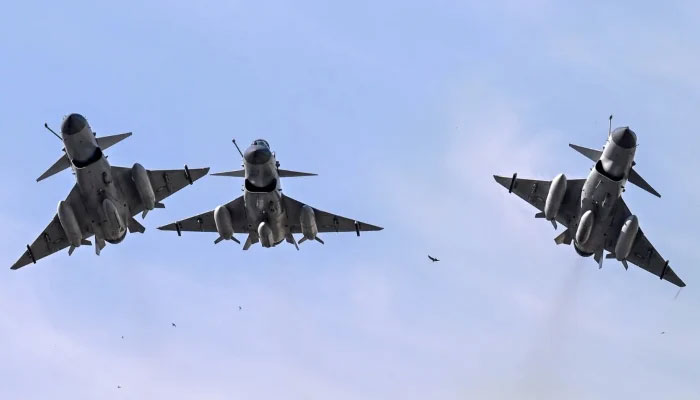
The ongoing conflict between India and Pakistan has already imposed significant economic burdens on both countries. On the military front, three primary cost components stand out: airstrikes, extensive drone deployments and elevated levels of combat readiness.
Assuming the Indian Air Force (IAF) conducts approximately 100 sorties per day using Rafale, Mirage 2000, Su-30MKI, and Tejas aircraft, the estimated fuel and operational cost per sortie is around $80,000. If precision-guided munitions (PGMs) such as SCALP EG, Spice 2000, Hammer, and laser-guided bombs (LGBs) are employed -- at a rate of 30 to 40 munitions per day -- individual weapon costs range from $100,000 to $1.1 million. Over a four-week period, the total cost of sustained airstrikes could reach approximately $6 billion.
For India, the daily deployment of approximately 30 unmanned aerial systems -- including Harop and IAI loitering munitions, along with Heron and Searcher drones -- supported by ISR operations, logistics, and electronic warfare (EW) assets, entails substantial expenditure. Factoring in UAV attrition and replacement, satellite bandwidth, ground control stations (GCS), and jamming capabilities, the estimated cost could reach $100 million per day -- totalling nearly $3 billion over a four-week period.
For India, the daily use of 10 BrahMos missiles -- launched from air, land or sea -- alongside 10 to 20 Pralay ballistic missiles or precision-guided MLRS, would result in an estimated expenditure of $150 million per day. Over a four-week period, this would amount to approximately $4.5 billion.
Under the category of ‘heightened readiness’, daily costs are substantial. Troop mobilisation and fuel consumption are estimated at $40 million per day. Maintaining air defence systems -- including the S-400, Akash, and BARAK-8 -- adds another $20 million daily.
Naval fleet readiness for both the Eastern and Western Naval Commands contributes an additional $50 million per day. Combined, these readiness expenditures total approximately $5.4 billion over a four-week period.
For the Pakistan Air Force (PAF), the combined cost of airstrikes and sustained combat air patrols is estimated at over $25 million per day -- amounting to roughly $1 billion over a four-week period. Drone operations, assuming the deployment of Turkish Bayraktar systems along with missile usage such as Ra’ad and Hatf-VII, are projected to cost an additional $450 million.
For Pakistan, heightened readiness and border alert -- encompassing troop movements, fuel consumption, radar activation, surface-to-air missile (SAM) deployments, and the mobilization of intelligence and signals intelligence (SIGINT) assets -- are estimated to cost $15 million per day, totalling approximately $450 million over a four-week period.
For India, in addition to direct military expenditures, the broader economic fallout includes four major cost categories. First, GDP disruption is estimated at $150 billion. Second, financial market volatility and currency depreciation could result in losses of up to $90 billion. Third, trade disruptions and supply chain breakdowns will lead to losses of around $80 billion. Fourth, foreign direct investment (FDI) inflows will shrink by around $100 billion.
For Pakistan, the indirect economic impact of the conflict will also be substantial. GDP disruption -- stemming from halted economic activity and overall economic uncertainty -- is estimated at $25 billion.
Financial market instability and currency depreciation, $15 billion. Trade and supply chain disruptions around $12 billion. Additionally, FDI inflows and IMF-related losses of $5 billion. Taken together, for both Pakistan and India, the total cost of the conflict over a four-week period is projected to exceed $500 billion.
The writer is a columnist based in Islamabad.


