
Remittances to reach $35bn in current fiscal: Aurangzeb
Govt will give policy framework and investors will remain key to achieve export-led growth, says finance minister
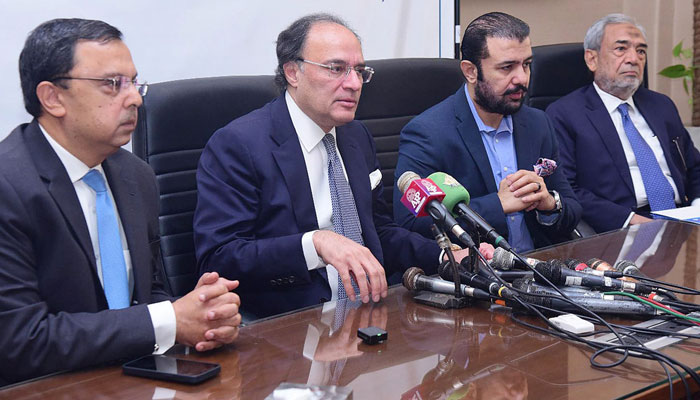
KARACHI: As PTI founder Imran Khan plans to ask overseas Pakistanis to stop sending money back home, Finance Minister Muhammad Aurangzeb on Saturday hoped the remittances would touch an all-time high at $35 billion in the current fiscal year.
Aurangzeb didn’t comment when asked about the call of PTI founder chairman about stopping workers remittances to Pakistan when he talked to the media at the Overseas Investors Chamber of Commerce and Industry (OICCI) in Karachi.
The minister claimed the country was able to achieve macroeconomic stability due to strenuous efforts of the last several months and the business confidence in the country restored. “We can’t be complacent now and have to remain on the course for achieving high growth through export-led strategy,” he declared.
The finance minister said the government would give the policy framework and investors will remain the key to achieve export-led growth.
He, however, pointed out that Pakistan has the dilemma of facing balance of payments problems as when the economic growth reaches four percent, we have to run back. “We need export-led growth for achieving 5-6 percent growth as presently the growth is largely dependent on imports,” he said. He said the business model cannot be run by evasion of sales tax.
Talking about state-owned entities (SOEs), Aurangzeb said these are causing the national exchequer a loss of Rs2.2 billion a day and the country sustained losses to the tune of Rs6 trillion in the last 10 years, which comes to around 50 percent of the revenue collection target set at Rs12.9 trillion for FY25. “Privatisation, liberalisation and deregulation are the way forward.” He said that foreign companies operating in Pakistan have repatriated profit and dividends worth $2.2 billion in May-June 2024, clearing the entire backlog of the repatriation to-date.
“Now there is no restriction on sending the repatriation from the Ministry of Finance and State Bank of Pakistan and it’s now up to commercial banks to facilitate the foreign companies in continuing to send profit and dividends without any delay,” he stated.
The minister said the government has nothing to do with rupee-dollar parity as it depends on the demand and supply of the greenback in the market, while market forces are determining the exchange rate instead of the government.
He said the government has prioritised inviting Foreign Direct Investment (FDI) in export-led projects and increasing exports to achieve sustainable economic growth. Emphasizing the need to improve the taxation system, he said that the old system of taxation can no longer go on. “We have to widen the tax net. The business model cannot be run by tax evasion, digitalisation systems are being brought in for checking tax evasion.”
The minister said efforts were being made to bring real estate, agriculture, wholesalers and retailers into the tax net. He said leakages in sales tax and income tax were being stopped through the digitalisation process.
He said that continuity of policies and political stability were requisite for development. Dharnas and rallies cause a loss of Rs190 billion per day.
Asked about the high prices of essential items despite the government’s claim of reduction in inflation, the minister said that inflation was decreasing, but people were not benefiting from it. The price of pulses, commodities and poultry and petroleum products was decreasing in the global market, but the price in Pakistan was increasing instead of decreasing. “We have to activate the price control committees to extend benefit to people.” He announced a crackdown on the middlemen to pass on the benefits of reduced prices of various items to end consumers. Replying to a question, Aurangzeb said talks are underway with the Sindh government regarding the agriculture tax. He said the Punjab government had already done work on it and Khyber Pakhtunkhwa and Balochistan were working on it.
Responding to a question about the IMF’s demand to charge sales tax on petroleum products, the minister denied that any such demand was made by the global institution.







-
 New Development In Blake Lively Lawsuit After Judge Dismisses Major Claims
 -
 Prince Harry’s Behavior Towards Queen Elizabeth Gets Exposed: ‘He Drove Her To Paranoia’
 -
 Blake Lively, Taylor Swift Texts Resurface After Court Ruling
 -
 Blake Lively, Justin Baldoni's Legal Case Receives Latest Update
 -
 Kylie Jenner Says Goodbye To Her Halloween Era: 'I've Retired It'
 -
 Mel B Reveals Why Spice Girls Documentary May Never Happen
 -
 Maggie Gyllenhaal Recalls Emotional Impact Of Seeing Husband With Other Woman
 -
 Scarlett Johansson Shares Wild First Concert Story
 -
 Inside King Charles, Queen Camilla's First US State Visit
 -
 Tiger Woods' Situation Deemed 'too Far Down The Line' After DUI Crash
 -
 List Of Blake Lively’s Dismissed And Allowed Claims Against Justin Baldoni
 -
 Dolly Parton's Rare Approach To Battle Grief Following Tragic Loss Of Late Husband Laid Bare
 -
 How Queen Elizabeth's Silence Impacted Diana And Meghan
 -
 Olivia Munn Raves About Her 'Your Friends & Neighbors' Costar James Marsden
 -
 Khloe Kardashian Gets Candid About Weight Loss Struggles
 -
 Jon Hamm Weighs In On ‘dark’ Modern Dating Culture: 'I Was Never Really Good At Dating Anyway'