
Minister launches power reforms project to foster economic growth
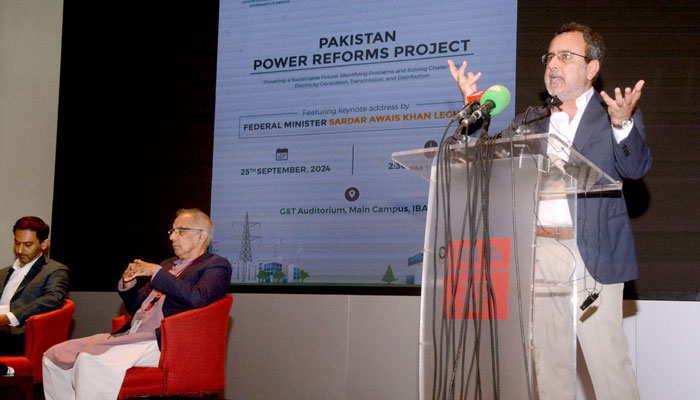
KARACHI: The Pakistan Power Reforms Project was launched at an event co-hosted by the School of Business Studies at IBA and the Ministry of Energy (Power Division).
In his keynote address, Federal Minister of Power Sardar Awais Ahmed Khan Leghari identified key challenges and outlined a clear roadmap for reforms aimed at improving the efficiency of the power sector, thereby catalyzing industrial and economic growth.
The minister said that structural reforms are multifaceted, with results expected to be evident within a few months. The Power Division is actively working to enhance the governance standards of distribution companies while advocating for a radical transformation of transmission infrastructure to improve efficiency and reduce losses. Regarding surplus generation capacity, he mentioned that plans are in place to stimulate industrial demand through various interventions to accelerate industrial and economic growth.
On the topic of tariffs, he noted that front-loaded debt repayments significantly contribute to capacity charges, and addressing this through various policy measures could lead to rationalized prices across the board. He also stressed the need to transition to a competitive market regime where electricity can be traded between buyers and sellers, thus rewarding efficiency and moving away from a cost-plus model focused on a single-buyer system.
The minister highlighted that a policy encouraging the adoption of electric vehicles will be announced soon, which will facilitate the uptake of electric two- and three-wheelers. “Such an intervention will not only increase electricity demand but also reduce household transportation expenses and significantly lower the import bill associated with fuel imports,” he stated.
He further mentioned that Pakistan boasts one of the cleanest energy mixes in the world, with over 55 per cent of electricity generated from clean sources, including hydel, nuclear and renewables.
This figure is expected to exceed 70 per cent within a few years. Almost 75 per cent of the electricity generated in the country comes from indigenous sources, a figure projected to rise to more than 90 per cent in the coming years.
The event concluded on a positive note, with a clear focus on a reform agenda aimed at improving governance standards and enhancing the efficiency of electricity generation, transmission, and distribution. This, in turn, could lead to lower electricity prices, triggering industrial and economic growth.







-
 Maren Morris Opens Up About Son Hayes's Love For Backstreet Boys
 -
 Kate Middleton Is Praised For ‘outshining’ Every Royal With Italy Visit
 -
 How Eddi Murphy's Parenting Rule Sparked Bella Murphy's Acting Passion
 -
 Prince William Presents FA Cup Trophy At Wembley Stadium
 -
 Nicole Kidman's Ex Keith Urban Plans To Expand Family Post-divorce
 -
 Natalie Harp: Meet The Blonde Who Credits Trump For Saving Her Life
 -
 Eurovision Song Contest Takes Place Amid Boycott
 -
 Meghan Markle Shares Adorable Moment As Princess Lilibet Helps Her Get Ready
 -
 Alec Baldwin Done With Hollywood After 'Rust' Tragedy?
 -
 Fake Images Used To Make Jennifer Lopez's Son Max's Legs Appear Thinner
 -
 Prince William Sings 'God Save The King' Before Manchester City, Chelsea Final
 -
 Kylie Jenner Faces 'damaging Accusations' From Former Housekeeper
 -
 Royal Horse Show Goes On After Soldier Dies In King Charles' Presence
 -
 Plastic Surgeons See Rise In AI-generated Beauty Requests
 -
 Man City Faces Crisis-hit Chelsea In FA Cup Showdown At Wembley
 -
 Research Reveals AI Is ‘not The Main Driver’ Of US Job Slowdown