
Fears grip ethnic minorities after deadly violence in Bangladesh
Protesters are calling for punishment of those responsible for unrest, which escalated, leading to deaths of at least four men from ethnic minorities
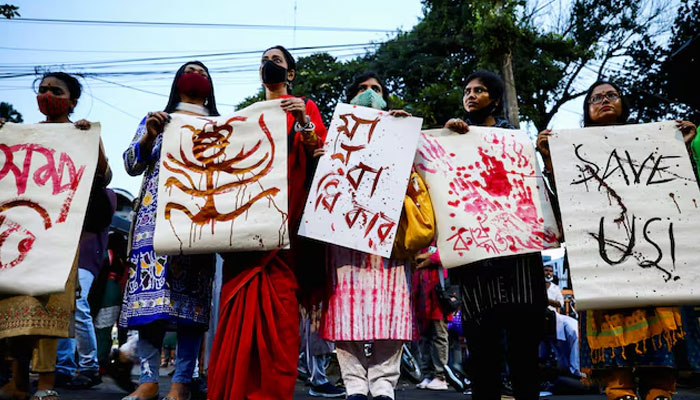
DHAKA: Ethnic minorities in Bangladesh’s southern hilly region are living in fear after clashes in which four people were killed and dozens wounded, police and witnesses said on Saturday.
Sectarian violence, sparked by the lynching of a Bengali man on Wednesday, has displaced scores of ethnic families after homes and businesses were set on fire in Chittagong Hill Tracts (CHT) bordering Myanmar and northeast India, they said.
A 72-hour road and waterways blockade, called by student-led ethnic groups, is underway in three hilly districts of Khagrachhari, Rangamati and Bandarban in the CHT, home to several indigenous tribal groups.
The protesters are calling for punishment of those responsible for the unrest, which escalated on Thursday, leading to the deaths of at least four men from ethnic minorities.
Many families in Khagrachhari and Rangamati have fled, leaving behind burning houses and businesses.
Despite heavy army, police and Border Guard Bangladesh patrols, residents remain on edge.
“A tense situation is prevailing... Police and security forces are jointly patrolling, hopefully, peace will restored soon,” said Ahsan Habib, deputy inspector general at Chittagong Range Police.
The Bengali man’s lynching triggered retaliatory attacks on ethnic minority communities, officials said.
Dozens of houses and businesses, primarily belonging to Buddhist minorities, were set on fire or attacked. Buddhist temples became targets, and loudspeakers in local mosques were used to incite Bengali mobs, witnesses said.
In response, local authorities have imposed Section 144, a curfew-like measure, in Khagrachhari and Rangamati.
The interim government led by Nobel Peace Prize laureate Mohammad Yunus, which took power after deadly protests that led to the ousting of Prime Minister Sheikh Hasina last month, has expressed deep regret over the violence. It has told all security forces to exercise maximum restraint and prioritise the safety of all residents.
A high-level committee will be formed to investigate the violence, Home Affairs Adviser Lt Gen (Retd) Jahangir Alam Chowdhury said after a meeting with local political leaders and various organisations.
In the 1980s, the government resettled thousands of landless Bengali families in the 5,500 sq miles (14,200 sq km) CHT, fuelling tension between the new settlers and indigenous groups.
In 1997, the then government of Prime Minister Sheikh Hasina signed a peace accord with the Shanti Bahini, a tribal guerrilla group, ending a 25-year insurgency that sought political autonomy for the region.







-
 Sofia Richie Grainge's Newborn Son's Nursery Is An Inspiration: Watch
 -
 Billy Ray, Noah Cyrus Take Fans 'on Our Way' In Heartwarming New Song
 -
 Robert Pattinson 'number One Thing' He Judges In Movies Amid 'The Drama' Release
 -
 'The Young And The Restless' Star Dee Freeman Passes Away At 66
 -
 Tragedy At Peru Football Derby: One Dead, 47 Injured In Rally At Alejandro Villanueva Stadium
 -
 Where Vanessa Trump Stands With Tiger Woods Amid DUI Drama
 -
 NASA Artemis II Moon Mission Captures Stunning Earth Images During Historic Lunar Journey
 -
 Kanye West And Lauryn Hill Send SoFi Stadium Into Total Meltdown: 'GOAT Is Back'
 -
 Canadian Citizenship New Eligibility Rules Explained: Who Qualifies And What Has Changed
 -
 Naomi Scott Reveals ‘encouraging’ Aspect Of Making Debut In Music
 -
 Polar Vortex Enters Final ‘seasonal’ Phase: Rare Shift Signals Winter Weather Risks Into April
 -
 Meta Pauses Mercor Work After Major Data Breach
 -
 A10 Warthog Hit As US Jet Downed In Iran, One Crew Rescued And Search Underway For Second
 -
 Zach Bryan Reveals Why He Cancelled Oklahoma Concert At Last Minute
 -
 Meningococcal Disease, Dangerous Bacterial Infection, Hits Decade High In Canada
 -
 Blake Lively's Latest Statement Shakes Up Legal Battle With Justin Baldoni