
Interesting facts about 2024 Indian polls, corporate donations and 5.5m EVMs
More than 968 million people, an increase of about 150 million people from 2019 election, out of a population of 1.4 billion people were eligible to vote
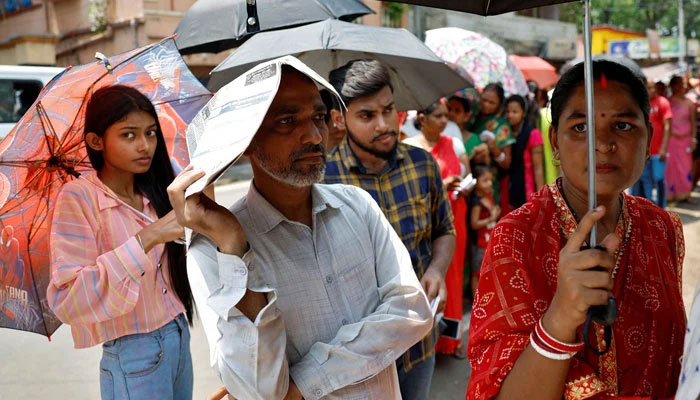
LAHORE: Held between April 19 and June 1 in seven phases to elect 543 members of the country’s Lok Sabha (National Assembly), Indian elections 2024 lasted a whopping 44 days, archival research shows.
More than 968 million people, an increase of about 150 million people from 2019 election, out of a population of 1.4 billion people were eligible to vote, equivalent to 70pc of the total population.
According to “Business Standard,” total estimated cost of 2024 Indian elections is well above Indian Rs1,000 billion (one trillion), which is equivalent to Pakistani Rs3.33 trillion.
In states like Arunachal Pradesh and Gujarat, even a solitary polling station was set up to accommodate the only registered voter in both places.
The polling station inside the Gir Forest in Gujrat was established to cater for a singular voter, a priest at a Hindu temple.
In March 2024, Indian Supreme Court had rejected a petition by Congress Party to end usage of Electronic Voting Machines (EVMs) machines and revert to paper ballots and manual counting, which was the system used in elections until the late 1990s. Congress had cited risks of electoral fraud.
Nearly 5.5 million EVMs have been used in the recent Indian polls for more than one million polling stations. Some 15 million election workers and security personnel were tasked with managing the conduct of election.
For the first time, Election Commission of India allowed voters with disabilities and those over the age of 85 to cast ballots from their homes due to concerns over high temperatures.
As far as private electoral donations for the purpose of campaign financing are concerned, top five recipients include Bharatiya Janata Party (BJP), which received private donations worth Indian Rs60.61 billion (equivalent to Pak Rs201.83 billion), All India Trinamool Congress (TMC) received a total of Indian Rs16.1 billion (Pak Rs53.61 billion), Indian National Congress rested at the third spot by receiving Indian Rs14.22 billion (Pak Rs47.35), Bharat Rashtra Samithi (BRS) encashed electoral bonds valued at Indian Rs12.15 billion (Pak Rs40.46) and Biju Janata Dal (BJD) received Indian Rs7.76 billion (Pak Rs25.84 billion).
Data published by the Election Commission of India reveals the lion’s share of BJP’s electoral bond donations came from the Hyderabad-based Messrs Megha Engineering and Infrastructures Limited (MEIL).
Between April 2019 and January 2024, this company donated a massive Indian Rs6.7 billion (Pak Rs22.31 billion) to the ruling party and Indian Rs1.28 billion (Pak Rs4.26 billion) to Indian National Congress.
The MKJ Group, a Delhi-based real estate and wealth management firm, donated Indian Rs3.9 billion (Pak Rs12.99 billion) to BJP, whereas Mumbai-based Messrs Qwik Supply Chain, a warehousing, storage and transportation company, donated Indian Rs3.7 billion (Pak Rs12.32 billion) to BJP, Rs3.6 billion (Pak Rs11.99 billion) to Trinamool Congress (a Mamta Banerjee-led Indian political party mainly influential in the state of West Bengal and is known as a breakaway faction from the Indian National Congress), and Rs1.6 billion to Indian National Congress.
Moreover, Messrs Future Gaming donated Indian Rs5.4 billion (Pak Rs17.98 billion) to All India Trinamool Congress. According to key Indian media outlets, Messrs Future Gaming and Hotel Services Private Limited in Tamil Nadu State is run by a 63-year-old “Lottery King” Santiago Martin, who has faced raids and probes by multiple law enforcement agencies in the last two decades over money-laundering, funds embezzlement and frauds.
Meanwhile, Messrs Haldia Energy, a West Bengal-based thermal power plant, donated Indian Rs2.8 billion (Pak Rs9.32 billion) to All India Trinamool Congress and Messrs Vedanta, an Indian multinational mining company headquartered in Mumbai, doled out Indian Rs1.25 billion (Pak Rs4.16 billion) for Indian National Congress.
According to May 21, 2024 edition of “India Today”, the first-ever Indian ballot exercise was held in 1951. Prior to this, India had granted universal adult suffrage to all of its citizens over the age of 21 years, which was further lowered to 18 years in 1989.
Right from its first election, India has been using a photosensitive indelible ink, which was developed to mark the fingers of those who cast their vote. This was done to prevent electoral fraud like double voting.
To this day, the special formula to create this ink has not been made public. In 1951, a factory in the suburbs of Bombay, had built the first-ever ballot box.
These ballot boxes were transported to the remotest parts of the country by various means, including trains, cars, camels and even elephants.


