
Turkey pushes alternative to G20’s India-ME trade corridor plan
Recep Tayyip Erdoan, president of Turkey, said after the G20 that “there can be no corridor without Turkey
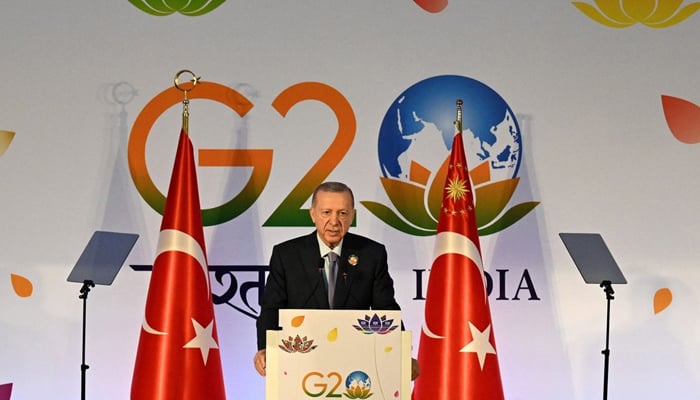
ANKARA: Turkey is in “intensive negotiations” over its alternative to the India-Middle East trade corridor plan that was agreed at this month’s G20 summit, as the country seeks to bolster its historic role as a transport route for goods moving from Asia to Europe, The Financial Times reported.
Ankara has pushed back against the proposed India-Middle East route that would transport goods from the subcontinent through the United Arab Emirates, Saudi Arabia, Jordan and Israel to European markets. The mooted corridor, backed by the US and EU as they attempt to repel China’s growing influence, would completely bypass Turkey. Recep Tayyip Erdoan, president of Turkey, said after the G20 that “there can be no corridor without Turkey”, adding “the most appropriate route for trade from east to west must pass through Turkey”.His foreign minister Hakan Fidan has since doubled down on the scepticism, insisting this week that “experts had doubts that the primary goal [of the India-Middle East corridor] was rationality and efficiency” and suggesting “more geostrategic concerns” were at play.“
A trade route does not only mean meeting trade alone. It’s also a reflection of geostrategic competition,” Fidan said in response to a question from the Financial Times.Turkey is keen to emphasise its traditional role as a bridge between east and west, a history that dates back centuries to the silk roads.Ankara has instead touted an alternative called the Iraq Development Road initiative, with Fidan insisting “intensive negotiations” were under way with Iraq, Qatar and the UAE about a project that would be forged “within the next few months”.
The proposed $17bn route would take goods from the Grand Faw port in oil-rich southern Iraq through 10 Iraqi provinces and into Turkey, according to diagrams released by the Baghdad government.The plan would rely on 1,200km of high-speed rail and a parallel road network. The scheme has three phases, with the first aiming for completion in 2028 and the last in 2050.
Analysts, however, say there are concerns over the feasibility of the Development Road project on financial and security grounds.“Turkey lacks the financing to realise the full scope of the project, and seems to be counting on UAE and Qatari support to build the proposed infrastructure,” said Emre Peker, Europe director at the Eurasia Group think-tank. “For that to happen, the Gulf states would need to be convinced of good returns on investment — something that is not imminently evident with the [Development Road] project.”
Peker added there are also “issues around security and stability that threaten both construction and the long-term feasibility of the project”.Iraq is blighted by rampant corruption, decaying infrastructure, weak government and regular bouts of political instability. It is also not clear how Iraq will finance the project.
Analysts and western diplomats have also noted the proposed G20 corridor could also be decades in the making, if it materialised at all.Turkey has sought to straddle the strategic line between west and east by attempting to maintain strong relations with the US and EU, and also Russia and China. The approach has at times stoked tensions with the west. This week, for example, two Turkish companies were hit with US sanctions for allegedly aiding Russia’s war against Ukraine.Ankara has generally been supportive of China’s Belt & Road initiative, Peker added, but he said its role in the scheme has been limited. Beijing has made about $4bn in investments in Turkey through Belt & Road, accounting for just 1.3 per cent of the total, according to a recent study by the Carnegie Endowment for International Peace.
Murat Ye ilta , director of foreign policy studies at Seta, a think-tank with links to Erdo an’s government, said that despite the alternative proposal, Ankara could yet push to join the India-Middle East initiative.
Erdo an may get an opportunity to make his case as soon as next week, if he meets with US counterpart Joe Biden on the sidelines of next week’s UN General Assembly.
Ye ilta said in addition to making a case about Turkey’s convenient geographical location for trade, the country can also flex its influence in the region, particularly after its recent warming of relations with Saudi Arabia and the UAE.“Turkey wields considerable political influence in the region [and is] capable of facilitating trade negotiations and resolving disputes among the countries participating in the corridor,” Ye ilta said.


