
Ancient Mars was wetter than thought, meteorite study reveals
Meteorite was discovered in 2022 in the desert in Mali
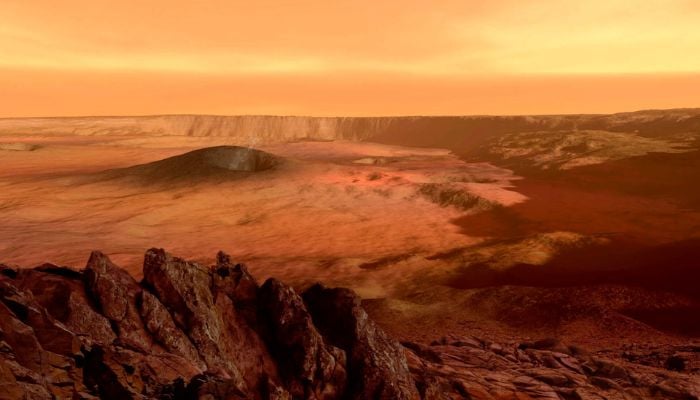
A 4.1-billion-year-old meteorite found in 2022 in the Sahara desert, approximately from the village of Bir Chali has a surprising yet previously unknown story to tell about the past of Mars.
Speaking about the features of the rock, it formed at least 4.1 billion years ago in the Martian crust, making it potentially the oldest of the 435 known Martian meteorites on Earth.
It is a coarse-grained igneous rock called gabbro, composed primarily of feldspar, pyroxene, and uranium-bearing zircon crystals.
Its distinct chemistry suggests it originated in Mars' southern highlands, possibly near the Hellas Basin.
Only three Martian meteorites date back to Mars’ early history. Teghaza 001 based on the rock’s composition, is believed to be older than the famous Antarctic meteorite discovered in 1984.
According to research it holds scientific significance, unlocking secrets about the ancient life on the Red Planet. Planetary scientist Yang Liu of NASA's Jet Propulsion Laboratory in California, which is managed by Caltech, called the meteorite "a witness to a time when Mars was likely warmer and wetter than it has been for most of its history."
Hydrogen and oxygen isotopes indicate that liquid surface water percolated deep into Mars’ crust and mixed with molten mantle rock over 4.1 billion years ago.
"Multiple lines of evidence in Teghaza 001 suggest Mars' surface had water more than 4.1 billion years ago. This is reflected by hydrogen isotopes in phosphate and oxygen isotopes in minerals and bulk samples," Liu said.
Planetary scientist and study co-author Lee Saper of NASA's Ames Research Center and the BAER Institute in California said the discovery bolsters the idea that primordial Mars was warmer, wetter, and had a thicker atmosphere, creating an environment that could have supported microbial life.
“But do not directly answer the question of whether there was life on Mars.”


-
 Astronomers observe massive puffy star merging with smaller companion
-
 NASA confirms Voyager 1 is now a ‘light-day’ away from Earth
-
 Google partners with Bezos’ Blue Origin to launch AI computing satellites in 2029
-
 ‘Craziest is definitely still yet to come’: HEO unveils advanced space intelligence platform in major new launch
-
 Anthropic vs SpaceX: How two potential IPOs compare
-
 EU climate chief says 'COP31 must drive clean energy shift'
-
 NASA smashed into an Asteroid-Hera’s first photos reveal a strange new world
-
 Could space data centers mark the end of stargazing?


