China sets world's first standard for AI brain implants
The new rule sets quality benchmarks for EEG data used to train AI brain-implant algorithms
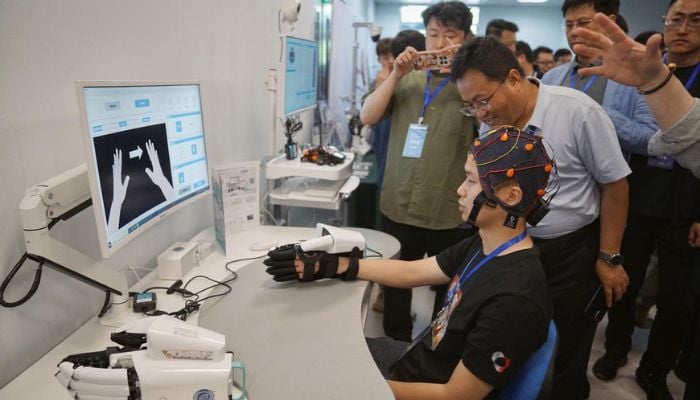
Brain-computer interfaces only work as well as the data that trains them, and China just became the first country to write that principle into medical-device law. The National Medical Products Administration (NMPA) approved a new standard this month governing how AI-powered BCIs process brainwave data, a world first for the sector.
This new regulation, which marks the third BCI medical device standard released by the NMPA in total, will focus on electroencephalogram datasets for training algorithms embedded in BCI devices.
This new rule provides requirements at all stages of the data lifecycle, including data acquisition, processing, labelling, storage, and access, as well as the ways to test the datasets' quality.
According to the NMPA, the regulation should be implemented at each stage of development, from the initial studies to production and quality control processes.
The operation of the BCI device is based on the high volume of EEG data to train the algorithms for decoding neural activity and predicting the actions intended by the patient.
According to the NMPA, the lack of proper quality control and inconsistency of the dataset generation process had become a constant issue in the industry, which could negatively impact the device performance.
The development of the BCI industry in China has seen a speedy move from laboratory to commercial products. It was due to this rapid transition that the NMPA decided to expedite the standard in question, avoiding the normal time period for its approval.
Such hurry resulted from the two BCI standards developed in China in 2025, both dedicated to terminology and testing performance of implantable neural stimulators, but not AI-processed data in particular.
The standard takes effect on September 1, 2027, giving device makers roughly a year to align their datasets and testing protocols before it becomes enforceable.


-
 Block’s Dessa AI voice model learned to talk without text: Here’s how
 -
 Sam Altman says AI is finding ‘Insane’ hardware-level bugs we never expected
 -
 iPhone Duo screen cracks after just six hours, users report
 -
 AI decodes Napoleon's cipher after 217 years in 6 hours
 -
 3 settings to stop Google personalised ads from Gmail data
 -
 Jack Dorsey’s Block launches Dessa AI voice model, but users aren’t happy
 -
 Moonshot AI restricts open-weight hacking ability in new Kimi model as fears grow over AI-powered cyberattacks
 -
 WhatsApp tests new filter to find mentions, replies faster