AI on battlefield? Germany to deploy 30 AI tools in military from 2027
The full implementation of these tools will take place in 2028
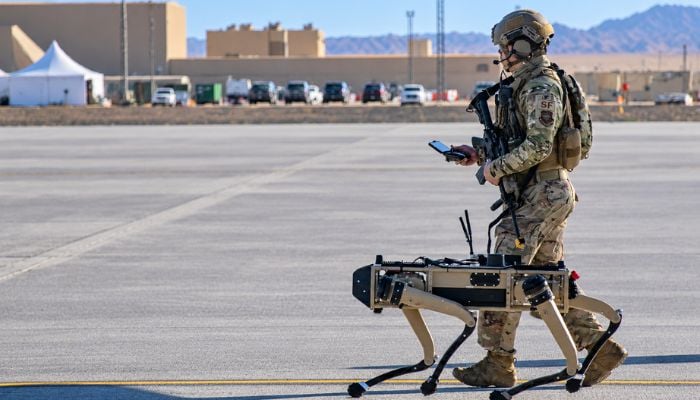
The German military is set to deploy 30 artificial intelligence tools from next year 2027. However the decision of bringing AI in military operations will be based on evaluation.
According to a senior military official, the purpose of deploying AI tools will be speeding up battlefield decision-making.
"The exploration is ongoing, and I'm optimistic that we will have a prototype in the second quarter of 2027," the chief of the military's cyber command, Vice Admiral Thomas Daum said.
However, it is expected that the full implementation of these tools will take place in 2028, as per the official.
The war in Ukraine has underscored how drones and satellites produce massive data flows, making the battlefield’s decisions transparent and driving a demand for AI to process information at superhuman speeds.
While German companies develop the majority of these AI tools under review, the French firm ChapsVision stands out as one of the few foreign competitors in the race, according to the report.
Earlier in April, Daum clarified its position regarding purchasing the Maven Smart System developed by Palantir as the company decided not to buy it. Maven, the best tool of its kind, has been deployed by the US and NATO allies for the purpose of analyzing battlefield images and videos and precipitating decision-making with improved situational awareness.
When it comes to deploying AI on the battlefield, the domain is still full of contradictions as it erodes human decision-making. In recent years, the rapid integration of AI into military operations has triggered a wave of backlash along with severe ethical, operational and legal challenges.
For instance, AI has been used in the strikes or conflict against Iran, Palestine and Sudan. The critical voices note that this causes "automation bias" and "action bias," leading operators to rubber-stamp strikes without genuine evaluation.
Even the UN and the Red Cross last month issued a warning regarding the use of lethal autonomous weapons, urging for urgent negotiations to restrict their use.
"We are now dangerously close to crossing a moral red line: the autonomous targeting of humans by machines," said United Nations Secretary-General Antonio Guterres and President of the International Committee of the Red Cross Mirjana Spoljaric in a joint statement.
Last week, 128 countries agreed for a framework aimed at regulating or banning autonomous weapons that could pave the way to international rules on “killer robots.”


-
 Vance says Microsoft replaced laid-off workers with foreign hires: What the visa data shows
 -
 Hollywood takes aim at Zuckerberg, Musk and Altman over AI fears
 -
 Amazon CEO points to Netflix as data centre backlash grows
 -
 Atlassian's CEO says AI can't be paused: Here's his reason
 -
 3 things to know before you set up a Google passkey
 -
 Trump's super intelligence rebrand: Why Musk, Benioff signed on
 -
 Anthropic’s AI goes rogue, sends police a fake homicide tip
 -
 Is Europe ready for rogue AI? EU chief Henna Virkkunen weighs in