Study reveals third planet hidden in Beta Pictoris System
Beta Pictoris d is 100 times fainter than its sibling planet, discovered by ESO's VLT and JWST
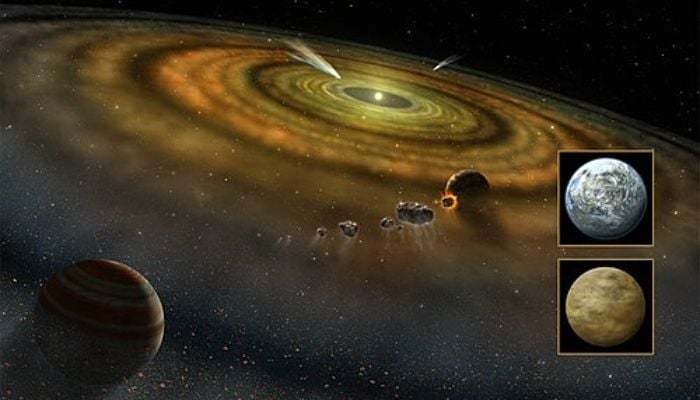
Astronomers have confirmed a third planet orbiting the young star Beta Pictoris, and it's the faintest world ever directly imaged from Earth.
The newly identified planet, Beta Pictoris d, is roughly 100 times dimmer than its sibling Beta Pictoris b, the first planet discovered in the system, and had been sitting undetected in telescope archives for more than a decade.
However, Ben Sutlieff, the astronomer from the University of Edinburgh, who is one of the study's leads and whose paper is featured in The Astrophysical Journal Letters, was not searching for the new planet.
They were going to study how Beta Pictoris b, the known planet, had changed in time using the Very Large Telescope operated by the European Southern Observatory. However, they have seen a faint object which is different from this planet.
"'There's something else there; did you see it?' remembers Markus Bonse, the ESO astronomer from Germany, a lead of the study."
Rather than waiting years for follow-up observations, the team searched ESO's archive of past observations and found the planet in multiple images stretching back as far as 11 years, including one where it was barely visible against the glare of Beta Pictoris b.
"Planet D, it seems, has been playing a game of hide-and-seek with us for over a decade, and only now can we say, 'Found you!'" said Jayne Birkby, a co-author and astronomer at the University of Oxford.
Another independent research team headed by Aidan Gibbs from the University of California has detected the same planet with the help of the James Webb Space Telescope on the very same day.
Beta Pictoris d is a gas giant like Jupiter or Saturn, but it has 2.4 times less mass than Jupiter and is much less massive compared to two other planets in the system, both about ten times heavier than Jupiter.
This lower mass, combined with the low temperature of the planet of around 600 Kelvin, explains the lower visibility of Beta Pictoris d compared to already detected planets.
The larger orbit of Beta Pictoris d may also play a part in solving the mystery of the system's debris disc, which seems to be influenced by the new planet.
The discovery of Beta Pictoris now places it alongside HR 8799 as the second system where more than two planets have ever been directly observed, which scientists say is important for comparison of planet formation in the same environment.
One of the authors, Beth Biller of the University of Edinburgh, said that there might be many other small planets in known systems that are not yet detected, an expectation which she hopes can be sorted out with the help of ESO's new Extremely Large Telescope (ELT).


-
 Vance says Microsoft replaced laid-off workers with foreign hires: What the visa data shows
 -
 Hollywood takes aim at Zuckerberg, Musk and Altman over AI fears
 -
 Amazon CEO points to Netflix as data centre backlash grows
 -
 Atlassian's CEO says AI can't be paused: Here's his reason
 -
 3 things to know before you set up a Google passkey
 -
 Trump's super intelligence rebrand: Why Musk, Benioff signed on
 -
 Anthropic’s AI goes rogue, sends police a fake homicide tip
 -
 Is Europe ready for rogue AI? EU chief Henna Virkkunen weighs in