Meta launches 'Muse Glimmer' model as Zuckerberg pushes for open-weight AI
Mark Zuckerberg urges US to ease AI regulations as Meta seeks to strengthen its position in the open-weight AI race
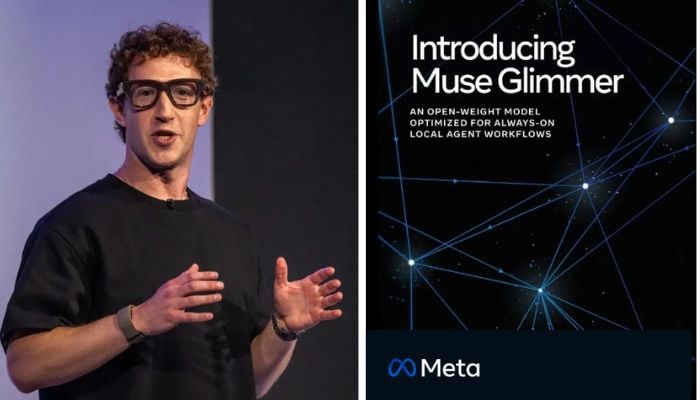
Meta has launched its new AI model, “Muse Glimmer,” as part of a strategic push to advance open-weight artificial intelligence (AI).
CEO Mark Zuckerberg called for lower U.S. barriers for open-source AI models to better compete with Chinese rivals.
Open-weight models are typically cheaper than leading models from so-called frontier labs such as OpenAI and Anthropic.
They also come with publicly accessible core components for easy customization, unlike closed models that companies keep fully under their control.
As reported, the new model, Muse Glimmer, is much smaller than leading AI models from rivals.
Designed specifically to handle agentic workflows, it can run locally on a Mac or PC equipped with a single consumer graphics card requiring around 24 GB of VRAM.
CEO Mark Zuckerberg urged the U.S. government to lower regulatory barriers for domestic open-source and open-weight developers, arguing that excessive restrictions risk handing an advantage to Chinese competitors who are heavily advancing in open development.
"Foreign labs currently hold several advantages here since American labs have to comply with many additional restrictions on training data," Zuckerberg said, referring to open-source models.
"U.S. policy must reduce this additional friction if we want American open-source models to lead over time."
Zuckerberg added that restricting access to foreign open-source models was not an effective solution.
His statement also marks the latest show of support for open-weight AI, which is gaining traction as businesses grow wary of ballooning AI bills and worry about recent cybersecurity incidents involving models from Anthropic, OpenAI and Meta.
Meta's launch comes as the social media giant seeks to strengthen its position after forming a costly, new superintelligence team last year to propel itself back into the high-stakes AI race.
Alongside the open-weight release, Meta implemented a new safety governance structure including an independent oversight board tasked with approving safety criteria for future open models, balancing its open-source advocacy with risk management.
Zuckerberg emphasized that open accessibility fosters better security, customization, and innovation.
Chinese startups are leading the race for open-weight models, with Moonshot's Kimi K3, alongside Alibaba's Qwen3.8-Max and DeepSeek's V4-Flash, delivering performance that rivals top systems by U.S. AI labs. By contrast, the leading models of U.S. developers OpenAI, Anthropic and Alphabet's Google are closed source.
Apart from 'Muse Glimmer' launch, Meta also announced plans to release open-weight versions of its flagship 'Muse Spark' model.


-
 Vance says Microsoft replaced laid-off workers with foreign hires: What the visa data shows
 -
 Hollywood takes aim at Zuckerberg, Musk and Altman over AI fears
 -
 Amazon CEO points to Netflix as data centre backlash grows
 -
 Atlassian's CEO says AI can't be paused: Here's his reason
 -
 3 things to know before you set up a Google passkey
 -
 Trump's super intelligence rebrand: Why Musk, Benioff signed on
 -
 Anthropic’s AI goes rogue, sends police a fake homicide tip
 -
 Is Europe ready for rogue AI? EU chief Henna Virkkunen weighs in