DeepSeek launches upgraded V4-Flash API with big agent gains: What developers need to know
The recent model structure and size of DeepSeek-V4-Flash-0731 are consistent with DeepSeek-V4-Flash preview after a post-training was re-conducted
The official version of DeepSeek-V4-Flash has reportedly launched, marking a significant departure from the previous hierarchical logic “Pro is strong while Flash is weak”, according to a Reuters literature review of the papers.
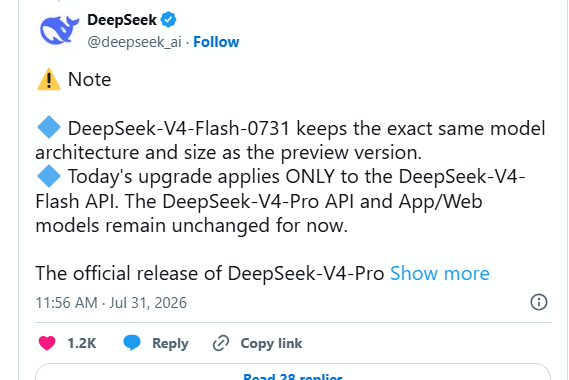
This update signals a major leap for the official Flash version, surpassing the level of the V4-Pro preview version three months ago across multiple agent benchmarks. DeepSeek documented in the release notes that the model structure and size of DeepSeek-V4-Flash-0731 are consistent with DeepSeek-V-4-preview and only post-training was re-conducted.
According to DeepSeek’s official technical report, V4-Flash has a total of 284 billion and 13 billion parameters. On the contrary, V4-Pro has a total of 1.6 trillion parameters and 49 billion activated parameters.
This marks the first time that DeepSeek’s self-developed Harness has presented publicly for the first time.
Implementation path of AGI
Liang Wenfeng once focused on the implementation path of AGI to climbing stars-the language model is the primary step, and this year’s step is Agent, and the issue that must be solved after Agent is continuous learning enabling continuous learning over time like humans instead of being fed the complete context every time to work.
DeepSeek’s significant improvement of Flash’s Agent capabilities
DeepSeek’s crucial improvement of Flash’s Agent capabilities in this update is strategically aimed at using cost-effective lightweight models to enter the massive market of agent applications.
The two substantial internal tests announced by the official also have clear goals: DSBench-Full Stack scored 68.7 and DSBench-Hard scored 59.6. This maintains DeepSeek’s lateral positioning from the side to build Flash into the preferred base for developers and Agent applications.
DeepSeek’s built-in compatibility for this format primarily means that developers can migrate agent applications developed based on the OpenAI ecosystem to DeepSeek at a lower cost.
The adaptation to Codex targets domain–specific generation and software development. Codex is OpenAI’s model for the code field, and DeepSeek's customized modification is equivalent to directly challenging OpenAI’s in the conventional profitable sector.
The launch of the official Flash version can be characterized as a technical delivery of DeepSeek supported by capital.
Nonetheless, with this crucial evolution of a lightweight model, DeepSeek has sparked a new debate across the sector as the benefits of post-training are fully booked, and the key efficiency improvements begin to close the gap in parameters.


-
 Trump's Super Intelligence Force: What to know
 -
 OpenAI Sam Altman warns of new safety risk: ‘AI becoming religious force’
 -
 Google’s £1bn battle over ‘hidden’ Play Store charges goes to trial in UK
 -
 Could AI be conscious? Why Anthropic is turning to the Vatican
 -
 Why Apple CEO John Ternus is taking a hands-on approach to design
 -
 New Open AI model could change the global AI race: Here’s how
 -
 Sam Altman faces new legal risks as OpenAI uncovers hacks
 -
 WhatsApp Channels are moving to your chats tab: What to expect