Can NASA save Swift Observatory telescope? Inside space agency's bold rescue mission
Rescue mission is budgeted at $30 million, compared to the original $250 million cost of telescope
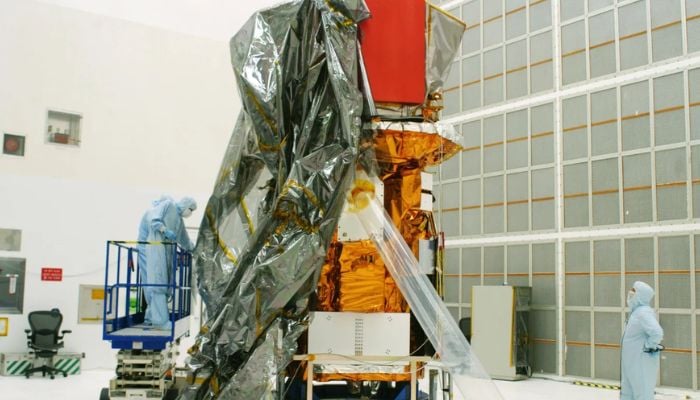
NASA is set to launch a robotic rescue mission on Tuesday aimed at saving the aging telescope that is currently falling towards Earth.
The objective of this daring mission is to rescue deteriorating Neil Gehrels Swift Observatory, which is currently losing altitude and at risk of burning up in Earth's atmosphere due to atmospheric drag.
The operation will use a robotic spacecraft named LINK which is developed by the startup Katalyst. The rescue mission, worth $30 million, is expected to span several months, with the initial launch scheduled for Tuesday at 10:23 GMT from the Pacific Ocean.
The launch will occur through a Pegasus rocket. The rocket will be air-launched from a jet rather than a traditional ground-based launchpad.
The robot will use three movable arms to latch onto the satellite and tow it to an orbit roughly 300 km higher. The rescue mission is going to be unprecedented with significant roadblocks coming in the way of this operation.
The greatest challenge faced by the engineers is not having a clear view of the telescope’s docking area. As a result, the success rate of this mission has been reduced to 50-50 percent chances.
"This is a lot of firsts stacked on top of each other," said Shawn Domagal-Goldman, the director of NASA's astrophysics division, during a recent call with reporters.
The Swift telescope was launched in 2004 for the purpose of a two-year mission. It is used to study gamma-rays bursts.
“Gamma-ray bursts are extremely brief, so the telescope was placed at an altitude of approximately 600 kilometers in low Earth orbit, so it could remain in constant communication with researchers.”
The telescope’s unique rapid response capability makes it difficult and expensive to replace. Therefore NASA is rushing to save it due to its high utility in the scientific community.
If successful, the operation is going to serve as a roadmap for saving the satellites and other space logistics. According to NASA and Katalyst, the mission would “pave the way for new possibilities in spacecraft management, and is worth a shot.”
The success will also prove the feasibility of a new model for “repairing, refueling, repurposing and upgrading satellites even if they were never prepared for it.”






-
 US finally confirms weapons in orbit: What it means for space warfare
 -
 How China's FAST telescope is mapping the cosmic gas behind star birth
 -
 Did Sun eat super-Earth? New study says maybe
 -
 Did Sun swallow a super-Earth? Scientists search for its ‘fingerprints’
 -
 Blue Origin sets sights on Mars with new NASA network
 -
 NASA, IBM launch open-source lunar foundation AI model to help map ice, craters on moon
 -
 Bacteria can remember without brain, new study finds
 -
 Fast radio bursts may unlock secrets of dark matter, energy and neutrinos