Robot dogs on Mars: Swiss researchers reveal how autonomy speeds up space exploration
A semi-autonomous robot is in the testing phase to explore Mars without constant human guidance
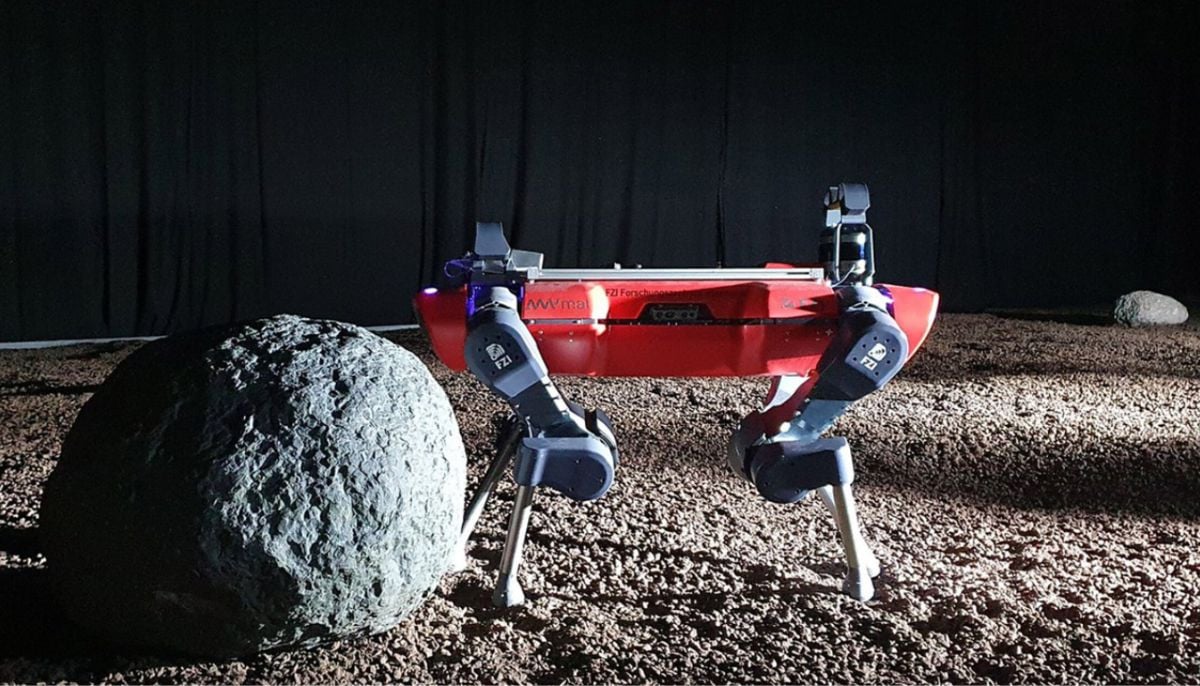
A new era of high-speed space exploration may be on the horizon as researchers at the University of Basel have successfully tested a semi-autonomous, four-legged robot capable of navigating Martian-like terrain three times faster than human-guided rovers.
The robot, a quadruped named ANYmal, recently completed a series of geological missions at the “Marslabor’ simulation facility. Outfitted with a specialized robotic arm and high-tech scanners, the robot demonstrated a level of independence rarely seen in planetary exploration. It uses a Raman spectrometer and microscopic imaging to identify complex minerals like gypsum, carbonates, and basalts, as well as lunar-analogue materials like anorthosite. Records show that ANYml completed missions autonomously in just 12 to 23 minutes, whereas a human operator doing the same job took 41 minutes. It is pertinent to note, however, that human oversight produced comparatively more detailed and accurate information.
Why it matters
Current Mars rovers are often restricted by communication lag, moving only a few hundred meters per day as they wait for instructions from Earth. The study also reinforces that legged robots prove to not only navigate obstacles but adjust to variable terrain, granting access to highly exposed areas. Taken together, these points together work to build a future in which robots like ANYmal are not merely tools, but active participants capable of independently hunting for biosignatures-the chemical traces could indicate ancient life on distant worlds.


-
 New study explains 364-day Qumran calendar puzzle
 -
 Why does time feel faster as you age? Science explains
 -
 Scientists name newly discovered snake after Guns N' Roses' Slash
 -
 SpaceX secures three new NASA crew flights: What to know
 -
 Sovereign AI fund in talks to back Political Sciences: What to know
 -
 What recent discovered Moon Crater Means for Future Astronauts
 -
 Scientists discover new wild cat species in Bolivia for the first time in a century
 -
 SpaceX turns to failed startups for AI training: Here’s why