Why NASA Artemis II mission matters for Trump’s ‘America First’ vision
Artemis II is scheduled to take off from Kennedy Space Center in Florida on Wednesday at 6:24 pm EDT
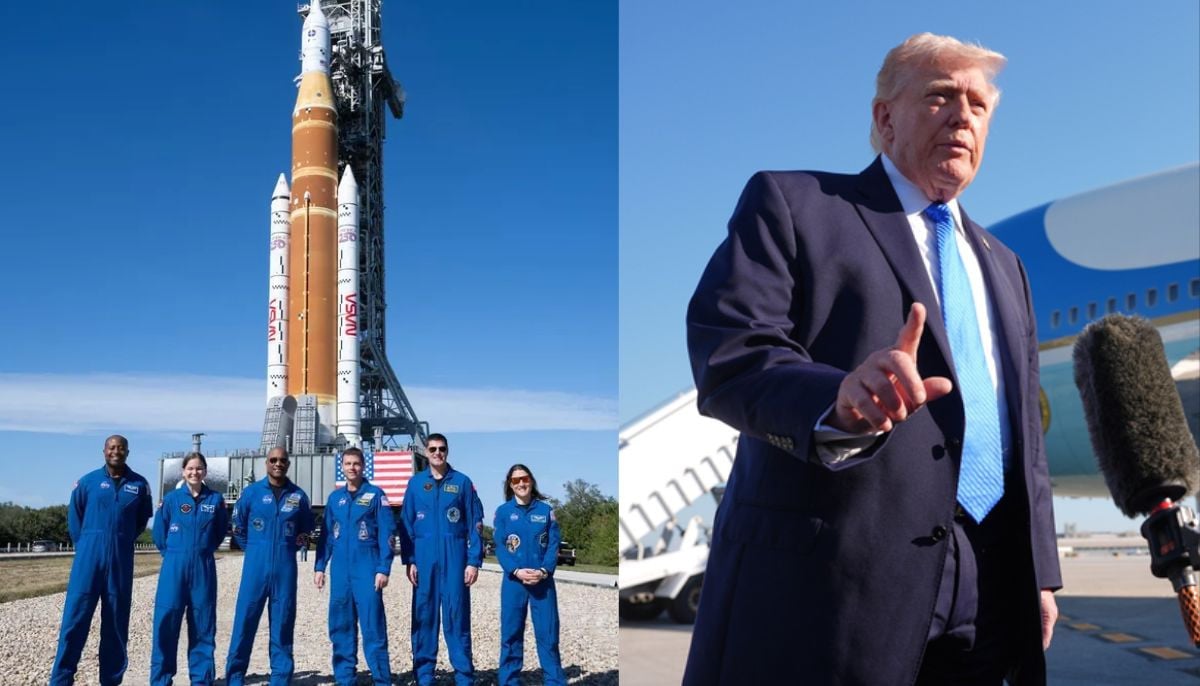
NASA’s much-awaited Artemis II mission is scheduled for Wednesday, April 1, 2026, highlighting humanity's first trip to the Moon after more than 50 years of wait.
Artemis II mission is not just a simple flyby to the Moon. The mission is the continuation of a story which was left unexplored more than fifty years ago.
The story is going to be rejuvenated again soon. It is not wrong to assume that the Artemis II mission stands on the precipice of a new era, a dawn of an age where space is no longer just a frontier for discovery, but a primary driver to advance Donald Trump’s “America First” agenda.
If the mission turns out to be successful, it will reimagine the cosmos as a domain for undisputed US leadership and dominance .
Under the Trump administration’s 2025 National Space Policy, Artemis II is not just a scientific milestone; it will accelerate a high-stakes race for “space superiority.”
Geopolitical strategy for space superiority
Unlike the Cold War against the Soviets, the competitor is China which is also advancing its lunar ambitions.
China is advancing its Chang’e 7 mission (launching mid-2026) to the lunar south pole. They aim for a human landing by 2030.
In the wake of China’s efforts, NASA administrator Jared Isaacman emphasizes that the US goal is not just flags and footprints on the lunar surface. In fact, the country is aiming to build a permanent presence to secure “high ground of space.”
Earlier this week, NASA unveiled a $20 billion plan to establish a lunar base on the moon’s surface.
The Trump administration views lunar superiority as a direct measure of American strength and prosperity.
Moon: A great frontier for resource independence
The mission is not just about expanding the influence on the lunar surface. It also involves the ambitions to explore the valuable resources hidden on the Moon.
According to the former NASA administrator Sean O' Keefe, the Moon is no longer viewed as a “dust bowl” and “barren land” but as a repository of immense economic value, calling it “lunar gold rush.”
The moon surface is known for containing a rare element called Helium-3 which “can be potentially used to operate small, compact nuclear fusion reactors with relatively long lifespans. That opens up all sorts of other opportunities,” said Keefe.
Currently the element trades for over $20,000 per kg.
Moreover, the moon also contains water ice (for rocket fuel) and rare earth minerals like lithium and platinum, which are essential for electronics and clean energy.
“The moon has water trapped in some of its minerals, and it also has substantial amounts of water at the poles," saidSara Russell, a planetary scientist at the Natural History Museum.
If the US becomes successful in accomplishing lunar mining, it could reduce its dependence on rare earth mineral markets in which China holds a dominant position, and advance the America First agenda.
Artemis II: Roadmap to Mars
For the US, Artemis II is not just a lunar mission; it paves the ways towards future Mars missions.
Trump has always hailed this mission a way for “American astronauts to plant the Stars and Stripes on the planet Mars”
According to Libby Jackson, head of space at the Science Museum, “Going to the Moon and staying there for a sustained period is much safer, much cheaper and much easier to be a test bed for learning how to live and work on another planet,” like Mars.
NASA also sees the lunar base as a critical preparation phase for sending humans to Mars as the lunar base allows NASA to refine life-support systems, such as air and water recycling, in a controlled environment.
A tool for national unity
Artemis II mission comes at a time when the US is grappling with political and social fragmentations.
This mission could become another historical precedent like Apollo 11. In 1969, despite the Vietnam War and civil rights unrest, an estimated 125 to 150 million Americans watched the Apollo 11 landing.
Astrophysicist David Gerdes hoped, "I would certainly hope that a return to the Moon by a group of Americans that is more diverse than those who took part in the 1960s can really help bring the country together."
This mission could become a moment of “America First” achievement.




-
 Self-exiled Chinese tycoon Guo Wengui sentenced to 30 years in US prison
 -
 Ex-Pentagon official makes chilling claim: UFOs provoke US military
 -
 Inmates stage daring takeover of Bertie-Martin Regional Jail
 -
 Paris mortuaries at capacity as heatwave death toll climbs
 -
 US Supreme Court allows Lisa Cook to remain at Fed
 -
 Car crashes into North Circular Bus stop, two injured
 -
 Germany Shooting: 5 adults killed at Stade Youth Centre, suspects detained
 -
 'Iran has requested a meeting': Trump announces surprise Doha talks
-
 Dangerous heat wave sweeps US before July 4: Which states will be hottest?
 -
Andy Burnham rules out Cabinet appointments until leadership race concludes
-
Will missing flight MH370 ever be found? Malaysia extends search until 2027
-
Spanish PM Pedro Sanchez faces pressure as wife Begona Gomez ordered to stand trial