PSX trades range-bound as IMF talks, global concerns weigh
KSE-100 Index drops by 2,119.55 points, or -1.29%, touching intraday low of 162,411.25
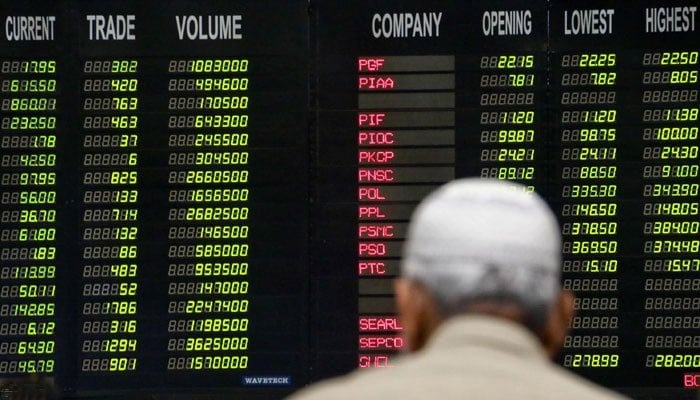
The stock market traded cautiously on Friday, fluctuating within a range as investors weighed Pakistan’s ongoing International Monetary Fund (IMF) review, persistent geopolitical and global economic headwinds.
“Stocks are under pressure amid security unrest and geopolitical uncertainty," said Ahsan Mehanti, Managing Director and CEO of Arif Habib Commodities.
"Weak global crude oil prices and weak global equities amid fears over the outcome of the US Govt shutdown, US tariffs played a catalyst role in bearish activity at PSX,” he added.
During intraday trading, the Pakistan Stock Exchange's (PSX) benchmark KSE-100 Index touched a high of 165,262.85 points, up 732.05 points, or 0.44%, and retreated to a low of 162,411.25 points, reflecting a decline of 2,119.55 points, or -1.29%, from the previous close of 164,530.8 points.
The US government shutdown entered its third week after senators once again rejected a Republican funding bill, with President Donald Trump ramping up pressure on Democrats as public services remain crippled. The impasse has unsettled global markets, raising concerns about fiscal stability and economic growth in the United States.
Back home, unresolved talks between Pakistan and the IMF over a staff-level agreement continued to weigh on sentiment. Sources told The News that disagreements persisted on external financing tables and the release of the Governance and Corruption Diagnostic (GCD) Assessment report, both key components of the IMF’s Memorandum of Economic and Financial Policies (MEFP).
Officials expressed optimism that these issues could be resolved within the next two weeks, paving the way for a deal.
Meanwhile, the State Bank of Pakistan (SBP) reported that overseas workers’ remittances rose 8.41% year-on-year in the first quarter (July–September) of FY2025–26 to $9.54 billion, compared with $8.80 billion in the same period last year.
September inflows stood at $3.18 billion, up 11.33%, led by remittances from Saudi Arabia ($750.9 million), the UAE ($677.1 million), the UK ($454.8 million), and the US ($269 million).
Adviser to the Finance Minister Khurram Schehzad said Pakistan received $38.3 billion in remittances last fiscal year and expects inflows to surpass $41 billion this year.
The SBP’s foreign exchange reserves increased by $20 million to $14.42 billion during the week ending October 3, even after the repayment of $500 million in Eurobonds. Total liquid reserves rose to $19.81 billion, while reserves held by commercial banks slipped by $6 million to $5.39 billion.
On Thursday, the KSE-100 Index had declined 735.94 points, or 0.45%, to close at 164,530.81 points from 165,266.75 points in the previous session. The index recorded a high of 166,729.97 points and a low of 164,306.77 points.


-
 Australian telecom shares tumble as SpaceX moves closer to direct-to-cell market
 -
 World Bank in crisis aid talks with dozens of nations amid global shocks
 -
 Deutsche Bank chief explains why German election results alarm foreign investors
 -
 China orders development of national blockchain network in economic blueprint: Here’s why
 -
 Tesla renames 'full self-driving' to 'assisted driving' in Europe: What to know
 -
 US sanctions ICC hours after former judge wins Nobel Prize: What to know
 -
 Trump holds millions in Meta stock: What to know
 -
 Amazon announces 1,000 corporate job cuts, primarily targeting retail division
-
 Coupang files lawsuits to contest record $462 million South Korean data breach penalties
 -
Google and Unity partner on new AI game creation platform
-
Sources reveal truth behind French brand Lacoste CEO getting fired ahead of Paris runway show
-
Canadian rents hit three-year September low after 24 months of declines